
May 18, 2026
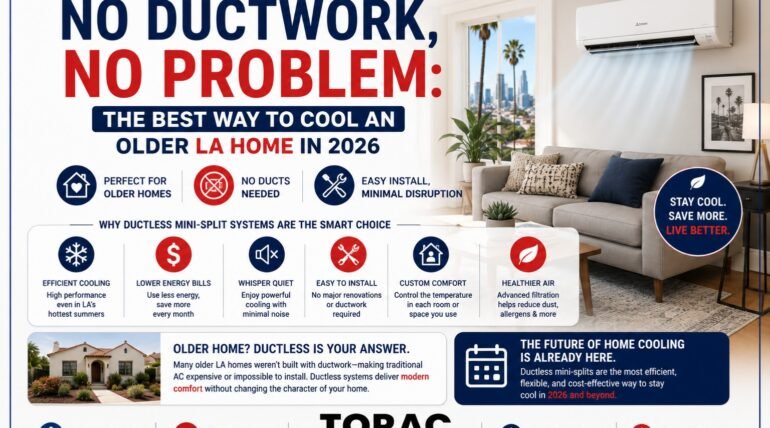
No Ductwork, No Problem: The Best Way to Cool an Older LA Home in 2026
Los Angeles has one of the most distinctive housing stocks of any major American city — a large proportion of homes built between the 1920s and the 1960s, many of which were constructed long before central air conditioning existed as a mainstream home feature. If you own one of these homes, you already know the problem: hot summers, no ductwork, and the uncomfortable reality that cooling the whole house properly has never been straightforward.
The old answer was to either suffer through it with window units, or commit to an enormously invasive and expensive central AC retrofit that meant opening walls, running ducts through attic spaces, and spending $12,000 to $22,000 before the system even turned on. In 2026, there is a better answer — and it has transformed how HVAC for older homes in Los Angeles with no ductwork gets handled. This guide covers all your realistic options, their true costs, their trade-offs, and exactly which solution makes financial sense for different home profiles.
Why So Many Los Angeles Homes Have No Ductwork
Understanding why ductwork is absent in so many LA homes helps frame the solution. The majority of homes built in Los Angeles before 1970 were designed around one of three original heating approaches: floor furnaces (common in bungalows and Craftsman homes from the 1920s to 1940s), wall heaters (common in post-war construction through the 1960s), or early forced-air furnaces that only served heating — not cooling — through minimal duct runs.
Air conditioning was not a standard residential feature when most of these homes were built. Window units were added room by room as they became affordable in the 1950s and 1960s. The result is a large share of the San Fernando Valley and greater LA housing stock — in neighborhoods like Canoga Park, Northridge, Reseda, Encino, Sherman Oaks, Chatsworth, and beyond — where there is simply no duct infrastructure to connect a central AC system to.
The average Los Angeles home is approximately 54 years old. A significant proportion of that housing stock falls squarely into this no-ductwork category.
Your Realistic Options: An Honest Comparison
There are four realistic approaches to cooling an older Los Angeles home without existing ductwork. Each has a legitimate use case — and each has significant limitations that make it the wrong choice for certain homeowners. Here is the honest version of each option.
Option 1: Window and Portable AC Units
The default solution for decades — and still a reasonable one in specific situations. Window units have improved significantly in efficiency and noise levels. Modern inverter-driven window units from brands like LG and Midea achieve SEER ratings of 12 to 15, meaningfully better than older units.
When this makes sense: Renters who cannot make permanent modifications to a property. Homeowners with very limited budgets who need immediate relief in one or two rooms. Short-term occupancy situations where the economics of a full installation do not justify the cost.
The real limitations: Window units cool rooms, not homes. Managing three or four separate units in different rooms is inefficient, noisy, and creates security vulnerabilities at window openings. Portable units are even less efficient — they exhaust hot air back into the space through imperfect exhaust hose seals and consistently underperform their rated capacity in real-world use. Neither option provides any heating capability. And neither solution is appropriate for a homeowner planning to stay in their property for more than 2 to 3 years — the economics simply do not hold up against a permanent installation.
Option 2: Whole-Home Central AC with New Ductwork Installation
The traditional solution that most older-home owners instinctively reach for first — only to discover the actual cost.
Installing a complete central AC system with new ductwork in an older Los Angeles home that has no existing duct infrastructure typically costs $12,000 to $22,000 — and in homes with complex layouts, finished ceilings, or limited attic access, can exceed $25,000. That cost includes the central system equipment, ductwork materials and labor, attic or wall penetrations, register installations, HERS testing, Title 24 compliance documentation, and permitting.
The installation is also physically invasive. Ductwork installation in an older home typically requires cutting into ceilings or walls to run trunk lines, working in tight attic spaces, and finishing work after the ductwork is installed. In a home with plaster walls and finished ceilings — common in pre-1960 LA construction — the disruption is significant.
When this makes sense: Homeowners planning a major renovation who can run ductwork while walls are already open. Properties where a whole-home uniform comfort solution is the absolute priority and budget is not a primary constraint. Homes with particularly challenging layouts that would require an impractical number of mini-split indoor units for full coverage.
The real limitation: For most older LA homes, this is the most expensive path to comfort by a significant margin — and the one that creates the most disruption during installation.
Option 3: High-Velocity Small-Duct Systems (SDHV)
A lesser-known option that deserves more attention in the historic and older-home market. High-velocity systems like Unico use small-diameter flexible tubing (approximately 2 inches in diameter) instead of conventional ductwork. These tubes can be threaded through existing wall cavities, between joists, and through tight spaces that conventional ductwork cannot reach — without the major demolition that standard duct installation requires.
High-velocity systems deliver conditioned air at higher velocity through small round outlets that can be placed nearly anywhere in a ceiling or wall. They provide genuine whole-home conditioning, handle both heating and cooling, and are particularly well-suited to historic homes and Craftsman bungalows where preserving original architectural features is important.
The trade-off is cost. High-velocity system installation in Los Angeles typically runs $15,000 to $25,000 for a whole-home installation — more than a mini-split solution in most cases, though potentially less invasive than conventional ductwork in certain home configurations.
When this makes sense: Historic or architecturally significant homes where preserving original interior finishes is a priority. Older multi-story homes where running conventional ductwork would require major ceiling work on multiple floors.
Option 4: Ductless Mini-Split Heat Pump System — The Most Common Solution
For the vast majority of older Los Angeles homes without ductwork, ductless mini-splits are the answer — and have been the dominant solution in this market for good reason. They require no ductwork, install with minimal structural disruption, provide both heating and cooling, achieve the highest SEER2 efficiency ratings of any residential system type, qualify for LADWP rebates, and are available in single-zone and multi-zone configurations that can address anywhere from one room to a whole home.
Installation involves mounting one or more indoor air handlers on walls or ceilings, connecting them to an outdoor compressor unit through a 3-inch penetration in the wall for refrigerant lines, power, and drain. No ductwork. No attic work beyond the line set penetration. A single-zone installation is typically completed in one day. A whole-home multi-zone system typically takes 2 to 3 days.
Mini-Split Costs for Older LA Homes in 2026
| System Configuration | Typical Installed Cost — LA 2026 | Best For |
|---|---|---|
| Single-zone (1 outdoor, 1 indoor) — 9,000–12,000 BTU | $3,500 – $5,500 | One room, studio, garage, ADU, or home office |
| Single-zone (1 outdoor, 1 indoor) — 18,000–24,000 BTU | $4,500 – $6,800 | Open-plan living area or primary bedroom zone |
| Two-zone (1 outdoor, 2 indoor heads) | $6,500 – $10,000 | Two-room coverage — living area + master bedroom |
| Three-zone (1 outdoor, 3 indoor heads) | $9,000 – $14,000 | Three-room coverage — typical smaller older LA home |
| Four-zone whole-home (1 outdoor, 4 indoor heads) | $12,000 – $18,000 | Whole-home coverage for 1,500–2,500 sq ft older home |
| Concealed ducted mini-split (1 zone, hidden in ceiling) | $5,000 – $8,500 | Rooms where wall-mounted units are unacceptable aesthetically |
Compare the four-zone whole-home mini-split at $12,000 to $18,000 against the central AC with new ductwork at $12,000 to $22,000 — and note that the mini-split option qualifies for LADWP rebates of up to $2,500 per ton while the central AC option does not. The economics tilt clearly toward mini-splits in most older LA home scenarios.
How Many Zones Does an Older LA Home Actually Need?
This is the question that determines whether a mini-split solution is affordable or expensive for your specific home. The answer depends on your home’s layout and how you actually live in it — not a formula based on square footage alone.
| Home Type / Layout | Recommended Zones | Reasoning |
|---|---|---|
| Studio or 1-bedroom home / ADU (under 700 sq ft) | 1 zone | Single unit with adequate BTU covers the space |
| 2-bedroom bungalow — open living area (800–1,200 sq ft) | 2 zones | One for living/kitchen area, one for bedroom wing |
| 3-bedroom home (1,200–1,800 sq ft) | 2–3 zones | Shared living zone + 1–2 bedroom zones |
| 3–4 bedroom home (1,800–2,500 sq ft) | 3–4 zones | Whole-home coverage — one zone per primary use area |
| Larger older home (2,500+ sq ft) | 4–6 zones | May require multiple outdoor units |
| Home where only specific rooms are routinely used | Target occupied rooms only | Zoning advantage — no need to cool unused rooms |
One of the key advantages of a zoned mini-split system over a central AC retrofit is that you only condition the spaces you actually use. An older 3-bedroom LA home where two bedrooms are used as offices and the third as a guest room that is rarely occupied can be effectively served by 2 to 3 zones rather than 4 — saving $3,000 to $5,000 on the installation while delivering equivalent comfort in the rooms that matter.
The LADWP Rebate Advantage for Older LA Homes
Mini-split heat pumps installed in older Los Angeles homes without ductwork qualify for the full LADWP Consumer Rebate Program — up to $2,500 per ton for systems meeting the minimum 15.2 SEER2 and 7.7 HSPF2 efficiency thresholds. This is a meaningful financial advantage over the central AC with new ductwork path, which does not qualify for comparable rebates.
For a real-world example: a three-zone Mitsubishi mini-split system installed in a 1,500 square foot older Canoga Park bungalow with no existing ductwork:
| Cost / Savings Item | Amount |
|---|---|
| Three-zone Mitsubishi mini-split — fully installed | $13,500 |
| LADWP rebate (approx. 2.5 tons total × $2,500) | − $6,250 |
| LADWP smart thermostat rebate (if applicable) | − $140 |
| Net out-of-pocket cost after rebates | $7,110 |
| Central AC with new ductwork alternative (no rebate) | $14,000 – $22,000 |
For LADWP customers, the net cost of a properly rebated mini-split installation is often significantly lower than any central AC with ductwork alternative — while also delivering superior efficiency and zoned comfort control. For the full rebate details, see: LADWP Heat Pump Rebate 2026: How to Qualify and Maximize Your Savings.
Mini-Split Options for Older LA Homes: Key Considerations
Wall-Mounted vs. Concealed Ducted Units
The standard wall-mounted indoor unit is the most cost-effective and most commonly installed option. Some homeowners in older LA homes — particularly those with Craftsman, Spanish Colonial, or Mid-Century Modern architecture — have aesthetic concerns about wall-mounted units. Concealed ducted mini-splits address this: they install inside the ceiling cavity and deliver conditioned air through small ceiling registers that are nearly invisible. They cost $1,500 to $3,000 more per zone than wall-mounted units but allow the system to disappear visually. For homes where interior aesthetics are a priority, this is the right choice for public-facing rooms.
Electrical Panel Capacity
A multi-zone mini-split system draws significant electrical load. Many older Los Angeles homes — particularly those built before 1970 — operate on 100-amp electrical service. A whole-home mini-split system may require a panel upgrade to 200-amp service to support the additional load. Panel upgrades in Los Angeles typically cost $1,500 to $3,500 depending on the scope of work and existing panel condition. Always have your contractor assess panel capacity as part of the installation evaluation — this cost should be budgeted from the start rather than discovered mid-project.
Line Set Routing and Aesthetic Impact
Refrigerant lines run from indoor units to the outdoor compressor. In newer construction, these can often be concealed within walls. In older homes with plaster walls or existing finishes, lines are typically run on the exterior of the home through painted line set covers. These are functional and discreet but visible on the home’s exterior. For homes where external line routing is a concern, discuss concealment options with your contractor before finalizing the installation plan.
Choosing the Right Brand for LA’s Climate
For older Los Angeles homes, the brand decision matters more than in a moderate climate because LA’s San Fernando Valley communities regularly experience temperatures exceeding 100°F. Systems that underperform at high ambient temperatures will struggle during peak summer heat waves. Mitsubishi Electric’s systems — with SEER2 ratings reaching 33.1 and confirmed performance in extreme heat — are the most consistently recommended for the San Fernando Valley’s climate profile. Daikin and Fujitsu are strong alternatives. For a complete brand comparison, see our detailed guide: Top 10 Mini-Split AC Brands in Los Angeles 2026.
California Permitting Requirements for Mini-Split Installation in LA
Mini-split installation in Los Angeles requires a mechanical permit from the Los Angeles Department of Building and Safety (LADBS). All work must be performed by a licensed C-20 warm-air heating or C-38 refrigeration contractor. The permit process for a straightforward residential mini-split installation is typically manageable and can often be handled via LADBS’s express permit system for standard residential retrofits.
The installation must also meet California Title 24 energy efficiency standards. Your licensed contractor handles permit application and ensures compliance — never work with a contractor who suggests skipping the permit to save money, as unpermitted HVAC work creates liability at resale, voids equipment warranties, and can affect homeowner insurance coverage.
Frequently Asked Questions
Can a mini-split heat and cool an older LA home?
Yes — and this is one of the most significant advantages over window units or portable AC. A mini-split heat pump handles both heating and cooling through a single system. For older LA homes with floor furnaces or wall heaters that are aging out, a mini-split installation can simultaneously replace the old cooling window units and the old heating system — two problems solved in one project.
How long does mini-split installation take in an older home?
A single-zone installation typically takes one day. A two or three-zone installation takes 1 to 2 days. A whole-home four-zone system takes 2 to 3 days. Installation in older homes with plaster walls or complex routing may add a day depending on the line set path chosen.
Will a mini-split cool my whole house or just individual rooms?
A properly sized multi-zone mini-split system can cool a whole home — each indoor unit conditions its zone independently. The key is correct sizing and placement of indoor units to ensure adequate coverage in each zone. A single-zone unit handles one area. Whole-home coverage requires a multi-zone system with indoor units placed strategically throughout the home.
Is a mini-split better than adding ductwork to an older home?
For most older LA homes, yes — on both cost and efficiency grounds. Installing new ductwork in an older home costs $12,000 to $22,000 for the ductwork alone before the system equipment. A whole-home mini-split system typically costs $12,000 to $18,000 fully installed with no ductwork required, qualifies for LADWP rebates, achieves higher SEER2 efficiency ratings, and avoids the energy losses that ductwork creates. The exceptions are homes where architectural constraints make mini-split placement impractical, or large homes where the number of required zones makes the system cost exceed the ductwork alternative.
Do mini-splits work during LA heat waves when temperatures exceed 100°F?
Quality mini-split systems — particularly Mitsubishi, Daikin, and Fujitsu models designed for hot climates — are rated to operate at outdoor temperatures up to 115°F and above. Choose a system with confirmed high-ambient performance ratings for San Fernando Valley installations where outdoor temperatures during heat waves regularly exceed 100°F. Undersized or lower-quality systems will struggle during peak heat events — proper sizing and brand selection are critical.
TOP AC Inc. — Mini-Split and HVAC Specialists for Older Los Angeles Homes
At TOP AC Inc., older homes without ductwork are some of our most common projects across the San Fernando Valley. We assess your home’s layout, recommend the right number of zones and unit placement, handle all permitting, and walk you through the LADWP rebate process so your installation qualifies for every dollar available.
We are a Mitsubishi Diamond Contractor — meaning our installations qualify for the full 12-year warranty on Mitsubishi equipment and the top tier of LADWP rebates. We serve homeowners throughout a 10-mile radius of our Canoga Park headquarters, including:
- Canoga Park 91303, 91304
- Woodland Hills 91364, 91367
- West Hills 91307, 91308
- Winnetka 91306
- Chatsworth 91311
- Northridge 91324, 91325, 91326
- Granada Hills 91344
- Porter Ranch 91326
- Reseda 91335
- Tarzana 91356, 91357
- Encino 91316, 91436
- Sherman Oaks 91403, 91423
📞 Call us at (855) 999-8672
🌐 top-ac.com
📍 21201 Victory Blvd, Suite 102, Canoga Park, Los Angeles, CA 91303
🕐 Available 24/7 — Residential & Commercial
Call today for a free on-site consultation — we will assess your home’s layout, recommend the right solution, and give you the exact cost and rebate numbers before any work begins.