
May 12, 2026
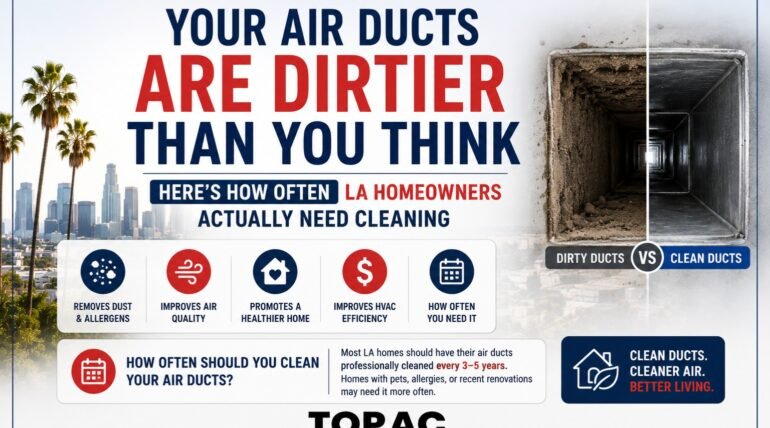
Your Air Ducts Are Dirtier Than You Think — Here’s How Often LA Homeowners Actually Need Cleaning
There is a question most Los Angeles homeowners either ignore completely or get wrong: how often does air duct cleaning in Los Angeles actually need to happen? The industry gets asked this constantly, and the honest answer is more nuanced than the “every year” some cleaning companies push — and more urgent than the “never, it’s a scam” camp would have you believe.
The truth sits in the middle, and it is shaped specifically by conditions unique to Los Angeles — wildfire smoke seasons, the San Fernando Valley’s extreme dust levels, the age of the local housing stock, and an AC cooling season that runs nearly year-round. This guide gives you the real, research-backed frequency recommendations for LA homes, the specific factors that accelerate that timeline, exactly what a professional cleaning involves, and what it costs in the 2026 LA market — so you can make an informed decision rather than a pressured one.
What the National Duct Cleaning Standard Actually Says
The National Air Duct Cleaners Association (NADCA) — the industry’s primary standard-setting body — recommends that residential air ducts be professionally cleaned every 3 to 5 years under normal household conditions. This is the baseline recommendation for a typical home with no unusual contributing factors.
Angi’s 2026 Los Angeles-specific data narrows this slightly, recommending every 2 to 4 years for LA homes — citing the city’s below-average air quality as a contributing factor that accelerates buildup compared to cleaner-air markets. Local contractors serving the San Fernando Valley and inland communities generally align with the shorter end of this range — every 2 to 3 years — for homes in dustier inland neighborhoods.
One important clarification: the EPA does not recommend duct cleaning on a routine schedule unless specific conditions are present — mold growth, pest infestation, or excessive debris restricting airflow. The EPA’s position is that cleaning is warranted when there is a documented problem, not simply as a preventive measure on a fixed calendar. This nuance matters because it places LA’s local conditions — not a marketing calendar — at the center of the frequency decision.
Why Los Angeles Homes Need Cleaning More Often Than the National Average
Several factors specific to Los Angeles genuinely accelerate how quickly ducts accumulate the kind of buildup that affects air quality and system efficiency — factors that national frequency guidelines do not fully account for.
Wildfire Smoke Seasons
This is the factor that separates Los Angeles from virtually every other major US city when it comes to duct cleaning frequency. During wildfire events — which in recent years have affected communities from Canoga Park and West Hills to the broader San Fernando Valley multiple times per season — fine particulate matter (PM2.5) infiltrates HVAC systems even when windows and doors are closed. Smoke particles are small enough to pass through standard filters, deposit on duct surfaces, and accumulate in return air systems.
Any home in Los Angeles that experienced significant smoke exposure during a major wildfire event should have its ductwork inspected and likely cleaned regardless of when the last cleaning occurred. This is not a sales pitch — it is a genuine indoor air quality issue with documented health implications. For a detailed look at how wildfire smoke affects indoor air quality and what to do about it, see our guide: Why Smoke Particles Linger Indoors and How to Eliminate Them Effectively.
The San Fernando Valley Dust Problem
Communities in the inland San Fernando Valley — Chatsworth, Granada Hills, Porter Ranch, Northridge, Reseda, Canoga Park, and Woodland Hills — experience significantly higher ambient dust levels than coastal LA neighborhoods. The combination of dry air, frequent Santa Ana wind events, and proximity to undeveloped desert terrain means that HVAC systems in these communities accumulate dust at a faster rate than the national baseline assumes. Homes in these areas should default to the shorter end of the cleaning frequency range — every 2 to 3 years — rather than the longer end.
The Age of LA’s Housing Stock
The average Los Angeles home is approximately 54 years old. A large proportion of the city’s residential housing was built in the 1950s, 1960s, and 1970s — with original ductwork that in many cases has never been professionally cleaned. Older ductwork in attic spaces accumulates not just dust but degraded insulation fibers, rodent activity debris in some cases, and decades of particulate buildup that genuinely affects both air quality and system efficiency. If your home was built before 1980 and you cannot confirm a prior professional duct cleaning, an inspection is warranted regardless of the standard frequency guidelines.
Year-Round AC Operation
Most US cities give HVAC systems a multi-month rest period each year. Los Angeles does not. A home in Woodland Hills or Northridge that runs its air conditioner from April through October — or longer — is circulating air through its duct system for the equivalent of 2 to 3 years of moderate-climate use in a single year. More runtime means more air volume cycled through the ducts, more particulate accumulation, and a shorter interval between cleanings needed to maintain equivalent air quality.
Your Personalized Cleaning Frequency: A Practical Guide
| Household Situation | Recommended Cleaning Frequency for LA Homes |
|---|---|
| Standard home, no pets, no allergies, no recent construction | Every 3–4 years |
| Home in dusty inland valley neighborhood (Chatsworth, Granada Hills, Northridge, Reseda, Porter Ranch) | Every 2–3 years |
| Home with one or more pets (dog or cat) | Every 2–3 years — pet dander accumulates significantly in duct systems |
| Household member with asthma, allergies, or respiratory condition | Every 2–3 years — more frequent if symptoms worsen seasonally |
| Home experienced significant wildfire smoke exposure | Inspect immediately — clean if buildup confirmed |
| Recent home renovation or remodel involving drywall, sanding, or demolition | Clean within 3–6 months of completion — construction dust is extremely fine and accumulates heavily |
| Newly purchased home with unknown duct cleaning history | Professional inspection immediately — clean if warranted |
| Home built before 1980, original ductwork never professionally cleaned | Clean now — establish a 3-year interval going forward |
| Home with confirmed mold growth in ducts or visible moisture damage | Clean immediately — address moisture source before cleaning |
| New HVAC system just installed | Wait 1 year before first cleaning — installation debris settles and should be removed |
Signs Your Ducts Need Cleaning Now — Regardless of Schedule
Frequency guidelines are starting points, not hard rules. These specific symptoms indicate your ducts need attention regardless of when the last cleaning occurred:
- Visible dust blowing from supply registers when the system first starts — a clear sign of significant accumulation at or near the duct openings
- Rapid dust accumulation on surfaces throughout the home — furniture and horizontal surfaces noticeably dustier within days of cleaning
- Unexplained worsening of allergy or asthma symptoms when the HVAC system is running, particularly if symptoms improve outdoors or in other buildings
- Musty or stale odor when the system runs — can indicate mold growth on duct surfaces or accumulated organic debris
- Uneven airflow between rooms that cannot be explained by vent position or thermostat settings — may indicate significant blockage in specific duct runs
- Visibly dirty air filter that needs replacing every 2 to 3 weeks rather than the normal 30 to 60 day interval — indicates abnormally high particulate load in the air being circulated
- Evidence of rodent activity in the attic or crawlspace — rodents frequently nest in and travel through ductwork, leaving behind debris and contamination that requires professional remediation
For a broader look at indoor air quality indicators and how to address them in LA homes, see: The Impact of Poor Indoor Air Quality on Allergies and Respiratory Health.
What a Professional Air Duct Cleaning Actually Involves
One reason duct cleaning has a mixed reputation is that the quality of the service varies enormously depending on the contractor. A legitimate professional cleaning is a multi-step process — not a shop vac run through your vents. Here is what a proper cleaning includes:
Step 1 — Pre-Cleaning Inspection
A reputable contractor performs a visual inspection of accessible ductwork before beginning any cleaning. This may include a camera inspection of main trunk lines to document the condition inside the ducts and identify any sections with mold, moisture damage, pest activity, or physical deterioration. The inspection outcome should drive the cleaning scope — not a pre-set package.
Step 2 — System Isolation and Negative Pressure Creation
A high-powered vacuum collection unit — truck-mounted or portable, with HEPA filtration — is connected to the main supply or return duct. This creates negative pressure inside the duct system, ensuring that dislodged debris is captured by the vacuum rather than blown into your living space. Any contractor who cleans ducts without establishing negative pressure first is not performing the cleaning correctly.
Step 3 — Mechanical Agitation of Duct Surfaces
Compressed air tools and rotating brush systems are used to dislodge accumulated dust, debris, and particulate from duct walls. This step is what separates a legitimate cleaning from a simple vacuum pass through the registers. Mechanical agitation reaches debris that has adhered to duct surfaces — the vacuum alone cannot remove it.
Step 4 — Register and Grille Cleaning
All supply and return registers are removed, cleaned individually, and reinstalled. This is often where the most visible accumulation occurs and where a quick-and-dirty cleaning will stop — but where a proper cleaning only begins.
Step 5 — Air Handler and Coil Inspection
A thorough cleaning should include inspection — and cleaning if warranted — of the air handler cabinet, blower wheel, and evaporator coil. These components accumulate the same particulate matter as the ducts themselves, and a duct cleaning that does not address the air handler leaves a significant source of contamination in place.
Step 6 — Post-Cleaning Verification
A NADCA-certified contractor will perform a post-cleaning inspection — ideally with camera documentation — to verify that the cleaning achieved the intended result before leaving your home. Request this documentation for your records.
What to Watch Out For: Duct Cleaning Red Flags in Los Angeles
The duct cleaning industry in Los Angeles has more than its share of low-quality operators who use bait-and-switch pricing, perform incomplete work, or recommend unnecessary additional services. Here is how to protect yourself:
- The $49 whole-house special: Legitimate duct cleaning in Los Angeles costs $221 to $449 for an average home. A quote significantly below $150 for a whole house is almost certainly either a lead generation hook for upsells or a service that will not include mechanical agitation, proper negative pressure, or air handler cleaning.
- Pressure to add antimicrobial treatments immediately: Chemical treatments applied inside ductwork should only be recommended when mold is confirmed by inspection — not as a standard add-on for every job. The EPA specifically advises against routine use of chemical biocides in ducts without documented need.
- No inspection before cleaning: Any contractor who quotes a price without first inspecting your system is guessing at scope. A professional contractor inspects first, quotes second.
- No NADCA certification: Ask whether the contractor has at least one NADCA-certified Air Systems Cleaning Specialist (ASCS) on staff. NADCA membership requires meeting specific quality and training standards that unlicensed operators do not meet.
Air Duct Cleaning Cost in Los Angeles in 2026
| Service | Typical Cost — Los Angeles 2026 | Notes |
|---|---|---|
| Standard residential duct cleaning — average home | $221 – $449 | Most LA homeowners pay around $335 per Angi 2026 LA data |
| Smaller home / condo (under 1,000 sq ft) | $150 – $250 | Fewer vents, less duct footage |
| Larger home (2,500+ sq ft, multi-zone) | $450 – $700+ | More registers, longer duct runs |
| Camera inspection add-on | $75 – $200 | Recommended for homes with unknown duct history or older ductwork |
| Dryer vent cleaning (often bundled) | $80 – $150 | Worth doing simultaneously — same access, significant fire risk reduction |
| Air handler / evaporator coil cleaning | $100 – $250 | Should be included or offered — address separately if not |
| Mold remediation (if mold confirmed) | $500 – $3,000+ | Scope-dependent — address moisture source first |
Pricing is typically calculated either per vent (common in LA — usually $25 to $45 per vent) or as a flat rate based on home size. Get an itemized quote that specifies the cleaning method, what equipment will be used, and whether the air handler is included before authorizing any work.
Does Air Duct Cleaning Actually Improve Energy Efficiency?
This claim is frequently overstated by cleaning companies. The honest answer is: it depends on how dirty your ducts are. The EPA’s position is that duct cleaning has not been shown to prevent health problems or consistently improve HVAC efficiency in homes where ducts are not significantly contaminated.
However, when ducts are genuinely heavily contaminated — significant dust buildup restricting airflow, debris accumulation in flex duct bends, or particulate coating on supply registers — cleaning can meaningfully restore airflow and reduce the strain on your blower motor. In those cases, efficiency improvements are real. The key word is significantly contaminated — not simply overdue on a cleaning schedule.
The most reliable efficiency improvements in your HVAC system come from consistent filter changes, annual professional tune-ups, and ensuring ductwork is properly sealed and insulated. For a complete picture of how maintenance habits affect your system’s performance and energy costs, see: How Proper Maintenance Improves Indoor Air Quality and Energy Efficiency and How Seasonal Tune-Ups Can Prevent Major Repairs and System Failures.
Frequently Asked Questions
How often should air ducts be cleaned in Los Angeles?
For most Los Angeles homes, every 2 to 4 years is the appropriate range. Homes in dusty inland San Fernando Valley communities, homes with pets, and homes that experienced wildfire smoke exposure should clean every 2 to 3 years. Homes with household members with asthma or allergies should also default to the shorter interval.
Is air duct cleaning worth it in Los Angeles?
Yes — when done by a qualified contractor under appropriate conditions. Los Angeles’s combination of poor ambient air quality, wildfire smoke seasons, dusty inland neighborhoods, and year-round AC operation makes duct cleaning more warranted here than in most US cities. The key is having a genuine inspection to determine whether cleaning is actually needed before paying for it.
How long does air duct cleaning take?
A proper professional cleaning of an average Los Angeles home typically takes 3 to 5 hours. Jobs quoted at under 2 hours for a full house are almost certainly incomplete — legitimate mechanical agitation of duct surfaces cannot be rushed.
Can I clean my own air ducts?
You can clean accessible registers and grilles yourself — remove them, wash them, and vacuum the first few inches of the duct opening. However, the interior surfaces of the duct system require professional equipment — specifically the high-powered vacuum and mechanical agitation tools — to clean effectively. DIY cleaning of duct interiors without proper equipment can disturb accumulated debris without removing it, potentially worsening air quality temporarily.
What is the difference between duct cleaning and duct sealing?
Duct cleaning removes accumulated debris from the interior of existing ducts. Duct sealing addresses gaps, leaks, and disconnections in the duct system that allow conditioned air to escape. They are separate services addressing separate problems — a dirty duct system may need both, or one without the other. For a full explanation of duct sealing and its costs, see: How Much Does It Cost to Replace Ductwork in Los Angeles?
Professional Air Duct Cleaning and HVAC Maintenance Across the San Fernando Valley — TOP AC Inc.
At TOP AC Inc., we inspect ductwork honestly — we will tell you whether your ducts genuinely need cleaning before recommending any service. We also perform complete HVAC maintenance that addresses the full system, not just the ducts in isolation, ensuring your air quality and system efficiency are addressed together rather than piecemeal.
We serve homeowners throughout a 10-mile radius of our Canoga Park headquarters, including:
- Canoga Park 91303, 91304
- Woodland Hills 91364, 91367
- West Hills 91307, 91308
- Winnetka 91306
- Chatsworth 91311
- Northridge 91324, 91325, 91326
- Granada Hills 91344
- Porter Ranch 91326
- Reseda 91335
- Tarzana 91356, 91357
- Encino 91316, 91436
- Sherman Oaks 91403, 91423
📞 Call us at (855) 999-8672
🌐 top-ac.com
📍 21201 Victory Blvd, Suite 102, Canoga Park, Los Angeles, CA 91303
🕐 Available 24/7 — Residential & Commercial
Call today to schedule a duct inspection — and find out honestly whether your home actually needs cleaning or not.