
April 14, 2026
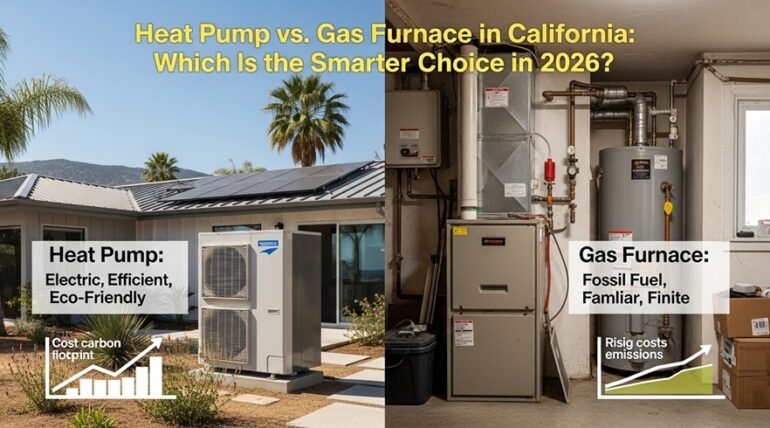
Heat Pump vs. Gas Furnace in California: Which Is the Smarter Choice in 2026?
If you are trying to decide between a heat pump vs gas furnace in California, you are not alone. It is one of the most common questions homeowners ask when their heating and cooling system reaches end of life — and the answer in 2026 is more nuanced, and more consequential, than it has ever been.
California’s utility rates have shifted. State electrification policy is accelerating. Major rebate programs have opened and, in some cases, already closed. And the way people heat their homes is fundamentally changing. This guide cuts through the noise and gives you a straightforward, accurate comparison so you can make the right decision for your Los Angeles home and budget.
How Each System Actually Works
Before comparing costs, it helps to understand the core difference in how these systems operate — because that difference drives every other calculation.
A gas furnace creates heat through combustion. It burns natural gas to produce flames that heat a metal heat exchanger, and air is then blown over that exchanger and distributed through your ducts. By the laws of physics, a gas furnace can never produce more energy than the fuel it consumes. Even the most efficient high-efficiency gas furnaces convert no more than 95–98% of the fuel they burn into usable heat — the rest is lost through flue gases and venting.
A heat pump does not create heat. It moves heat that already exists in the outdoor air and transfers it into your home. Because moving heat requires far less energy than generating it, a properly sized heat pump delivers 2.5 to 4 units of heat energy for every single unit of electricity consumed. That is an efficiency rating of 250–400%, a thermodynamic advantage that no combustion system can match.
This distinction is the foundation of the entire comparison. In California’s climate, where winters are mild and outdoor temperatures rarely challenge a heat pump’s performance, this efficiency advantage is especially pronounced.
The Comparison That Actually Matters: System vs. System
One mistake homeowners frequently make is comparing a heat pump only against a gas furnace. This is the wrong comparison. A gas furnace only heats — it does not cool your home. You still need a separate air conditioner for summer.
The correct, apples-to-apples comparison is:
- Heat pump (handles both heating and cooling in one unit)
- vs. Gas furnace + central air conditioner (two separate systems)
When the comparison is framed correctly, the upfront cost gap between the two approaches is much smaller than most homeowners expect — and in many cases disappears entirely once available incentives are applied.
Upfront Installation Costs in Los Angeles (2026)
| System | Typical Installed Cost (Los Angeles) |
|---|---|
| Gas furnace only (replacement) | $4,000 – $7,500 |
| Central air conditioner only (replacement) | $5,500 – $9,000 |
| Gas furnace + AC combined | $9,500 – $16,500 |
| Air-source heat pump (ducted, replacing both) | $9,500 – $15,000 |
| Ductless mini-split heat pump (single zone) | $4,200 – $6,800 |
As the table shows, when you factor in the cost of both a furnace and an air conditioner, a ducted heat pump installation in Los Angeles is directly competitive on upfront cost. For homeowners whose furnace and AC are both aging, replacing them with a single heat pump is often the financially equivalent — or cheaper — path, especially before incentives.
Operating Costs: The Real Difference Over Time
Southern California Edison’s average residential electricity rate as of early 2026 is approximately $0.33–$0.35 per kWh depending on your plan and tier. SoCalGas rates have climbed significantly over the past two years. For most Los Angeles homeowners served by LADWP, electricity rates are generally lower than SCE customers.
Here is why the efficiency math still favors heat pumps despite higher per-kWh electricity costs: a modern heat pump operating in LA’s mild climate runs at a real-world efficiency of 300–400%. That means you are effectively paying for 1 unit of energy but receiving 3 to 4 units of heating output.
A high-efficiency gas furnace running at 95% AFUE converts 95 cents of every dollar of gas into heat. A heat pump running at 300% efficiency converts $1 of electricity into $3 worth of heat. Even accounting for California’s higher electricity prices, the heat pump wins — particularly in a mild climate like Los Angeles where the system spends most of its operating life at peak efficiency.
Additional operating savings come from eliminating your gas service connection fee entirely if your home transitions to all-electric. For most SoCalGas customers, this is a fixed monthly charge that adds up regardless of how much gas you use. Removing it adds measurable long-term savings.
Over a full 15-year system lifespan, Southern California homeowners who switch from gas to a heat pump typically save between $9,000 and $18,000 in total operating costs compared to maintaining a separate furnace and AC setup, according to local HVAC industry data.
The 2030 Gas Furnace Sales Ban: What Los Angeles Homeowners Need to Know
California has set a target to ban the sale of new gas furnaces and gas water heaters beginning in 2030. To be clear, this does not affect existing equipment — if you install a gas furnace in 2026, it can continue operating until it naturally reaches end of life. However, the policy has meaningful implications:
- By the time a 2026 gas furnace reaches end of life (typically 15–20 years from now), the market for gas HVAC equipment, repair parts, and specialist contractors will look very different.
- Future homebuyers and real estate appraisers are increasingly aware of the electrification direction, and an all-electric home may carry a stronger market position as the 2030 deadline approaches.
- Installing a heat pump now locks in access to current rebate programs, which are far more generous than anything likely to be available closer to the mandate deadline.
This does not mean every Los Angeles homeowner must replace a functioning gas system today. But it is a relevant factor when your existing equipment is aging and you are weighing a long-term investment.
Rebates and Incentives: Who Qualifies Right Now
This is where the financial picture for heat pumps in Los Angeles is genuinely compelling in 2026 — but it requires accuracy, because the landscape has changed.
LADWP Heat Pump Rebate
Los Angeles Department of Water and Power customers can access an incentive of up to $2,500 per ton for qualifying heat pump systems. On a standard 3-ton whole-home system, this represents up to $7,500 in direct incentives. Higher SEER2-rated equipment typically qualifies for the top tier.
GoZero Program (South Coast AQMD)
The GoZero program offers rebates of $1,000 to $3,000+ for ENERGY STAR certified, zero-NOx heat pumps installed in the South Coast Air Quality Management District — which covers Los Angeles County. Unlike some programs that required pre-installation reservations, GoZero allows post-installation applications, lowering the barrier to participation. Equipment must meet zero-NOx emission standards and be ENERGY STAR certified.
Federal Tax Credit (IRA Section 25C)
The Inflation Reduction Act provides a 30% federal tax credit up to $2,000 for qualifying heat pump installations. This is a direct dollar-for-dollar reduction in your federal tax liability. Consult your tax professional to confirm eligibility and the correct tax year for your project.
HEEHRA — Current Status
The HEEHRA program, which offered up to $8,000 for income-qualified households, has been fully reserved statewide as of February 24, 2026. A waitlist exists in case additional funding becomes available. If you are income-qualified, ask your contractor about the waitlist and monitor for future funding announcements.
Important note: Gas furnaces do not qualify for any of these heat pump-specific incentive programs. The entire rebate and tax credit stack is available exclusively when choosing a heat pump.
When a Gas Furnace Still Makes Sense
A balanced comparison has to acknowledge the scenarios where replacing only a furnace is a reasonable choice:
- Your air conditioner is new and working well, and only your furnace needs replacement. Installing a heat pump in this situation means replacing functional equipment before its time, which is rarely cost-effective.
- Your electrical panel cannot support a heat pump without a significant upgrade, and the combined cost of panel upgrade plus heat pump installation exceeds your budget significantly.
- You are a landlord managing a rental property with tight margins and a limited stay horizon.
In these specific situations, a high-efficiency gas furnace replacement at $4,000–$7,500 may be the pragmatic decision. The key is that this choice is made with a clear understanding that the replacement system will not qualify for available incentives, and that its long-term operating economics in a mild California climate are less favorable than a heat pump.
Side-by-Side Summary
| Factor | Heat Pump | Gas Furnace + AC |
|---|---|---|
| Heating & cooling | Both in one system | Two separate systems required |
| Upfront cost (installed, LA) | $9,500 – $15,000 | $9,500 – $16,500 combined |
| Operating efficiency | 250–400% | 80–95% (heating only) |
| Carbon monoxide risk | None | Present if not properly maintained |
| Qualifies for LADWP rebate | Yes — up to $2,500/ton | No |
| Qualifies for GoZero rebate | Yes | No |
| Federal tax credit (IRA) | Yes — up to $2,000 | No |
| California 2030 outlook | Future-proof | Sales ban on new units |
| System lifespan | 15–20 years | Furnace 15–20 yrs / AC 12–15 yrs |
| Annual maintenance | One system to service | Two systems to service |
Frequently Asked Questions
Is a heat pump more expensive to run than a gas furnace in California?
In most cases in Southern California, no. Heat pumps operate at 250–400% efficiency, which offsets higher electricity rates. In LA’s mild climate, heat pumps spend virtually all of their heating season at peak efficiency, making them cost-competitive with — or cheaper than — gas in most scenarios.
Can a heat pump fully replace a gas furnace in Los Angeles?
Yes. A properly sized ducted heat pump or ductless mini-split system handles both heating and cooling completely, eliminating the need for a separate furnace.
Will California ban my existing gas furnace?
No. The 2030 ban applies to the sale of new gas furnaces and water heaters, not existing equipment. If you install a gas furnace today, it can operate until end of life.
What happens to a gas furnace after the 2030 ban?
Existing gas furnaces can continue operating. However, as the customer base for gas appliances shrinks, availability of parts, specialized contractors, and potentially gas infrastructure itself may become more limited and costly over the following decades.
Talk to a Los Angeles HVAC Expert Before You Decide
The right answer depends on your home’s specific profile — age, ductwork, electrical panel capacity, your utility provider, how long you plan to stay, and your budget. A licensed, experienced HVAC contractor can evaluate all of these factors and give you an honest recommendation.
At TOP AC Inc., we install both heat pumps and gas systems across Los Angeles and the surrounding communities. We will not push you toward the more expensive option — we will assess your home and give you the real numbers for your specific situation. Our licensed technicians provide free on-site consultations and handle permitting and rebate documentation.
📞 Call us at (855) 999-8672
🌐 Visit top-ac.com
📍 21201 Victory Blvd, Suite 102, Canoga Park, Los Angeles, CA 91303
🕐 Available 24/7 for residential and commercial clients throughout LA
Schedule your free consultation today — and get the honest comparison your home deserves.