
May 21, 2026
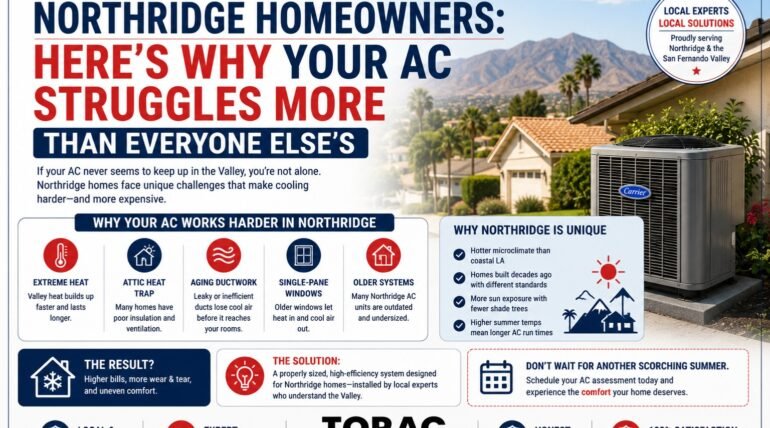
Northridge Homeowners: Here’s Why Your AC Struggles More Than Everyone Else’s
If you live in Northridge and your air conditioner seems to work harder than it should — running longer, struggling to keep up on hot afternoons, needing more frequent repairs than your neighbors in cooler parts of LA — you are not imagining it. Northridge genuinely places more stress on HVAC systems than most neighborhoods in Los Angeles, and the reasons are specific, measurable, and worth understanding before you spend money on repairs that might not address the root cause.
This guide covers why AC repair in Northridge, CA is a different challenge than in coastal or milder parts of the city, what the most common failure points are for Northridge homes specifically, what repairs cost in the local 2026 market, and how to make smart decisions about repair vs. replacement given the unique demands this neighborhood puts on HVAC equipment.
Why Northridge Is One of the Hardest Places in LA to Keep an AC Running
Northridge sits in the central San Fernando Valley — landlocked, far from the moderating influence of the ocean, and in a geography that creates its own intense microclimate. Understanding what your system is dealing with every summer explains why AC problems in Northridge are so common and why they are often more serious than a simple filter change or refrigerant top-off.
Temperatures That Regularly Exceed 100°F — Sometimes 110°F
Northridge and its neighboring communities routinely record some of the highest temperatures in Los Angeles County during heat waves. While coastal areas like Santa Monica may sit at 75°F, Northridge can simultaneously be at 105°F or above. During the significant heat dome events that have occurred regularly across the San Fernando Valley in recent years, Northridge has recorded temperatures exceeding 110°F.
This matters for your AC because the system’s condenser — the outdoor unit — rejects heat into the surrounding air. When outdoor air temperature climbs above 95°F, the condenser’s ability to reject heat efficiently drops sharply. The compressor works harder, draws more electrical current, generates more internal heat, and degrades faster. A system that might last 17 years in a moderate coastal climate may reach end of life in 12 to 14 years in Northridge’s heat environment — and will need more frequent repairs throughout that lifespan.
A Cooling Season That Never Fully Ends
Northridge homeowners run their air conditioners earlier in spring and later into fall than residents of most other LA neighborhoods. In a typical year, active cooling in Northridge runs from late March through October — and October heat waves push that into November. That is up to 8 months of active cooling per year, accumulating operational hours on the compressor, capacitors, contactors, and fan motors at a pace that accelerates wear significantly compared to national HVAC lifespan averages.
Dust and Dry Air From the Valley Floor
Northridge’s inland position, combined with Santa Ana wind events and the dry desert-influenced air that flows through the San Fernando Valley, creates elevated ambient dust levels compared to coastal LA. This dust accumulates rapidly on air filters — which should be changed every 30 days in Northridge homes during the cooling season, not every 60 to 90 days as packaging often suggests. It also coats condenser coil fins on outdoor units, reducing heat rejection efficiency. A condenser coil caked with dust and debris in Northridge’s dry heat is one of the most common causes of compressor overwork and premature failure in this neighborhood.
Older Housing Stock With Aging Systems
Northridge contains a large proportion of homes built in the 1960s through 1980s — the post-war residential expansion that defined much of the San Fernando Valley. Many of these homes still have original or first-replacement HVAC systems that are 15 to 25 years old, operating in one of the most demanding climates in the region. A 20-year-old system that was adequately maintained might survive another few years in a mild climate — in Northridge’s heat, it is typically a season or two from failure.
Most Common AC Repairs in Northridge Homes
The combination of extreme heat, dust, and extended cooling seasons creates a predictable pattern of AC failures in Northridge. These are the repairs our technicians respond to most frequently in this neighborhood:
| Repair Type | Why It Happens More in Northridge | Typical Cost — 2026 | Repair or Replace Trigger |
|---|---|---|---|
| Capacitor failure | Heat stress — capacitors degrade faster above 95°F ambient. Most common repair on systems over 7 years in valley heat | $150 – $400 | Repair on systems under 12 years old |
| Condenser coil clogged / dirty | Valley dust accumulates on fins — reduces heat rejection, causes high head pressure, overworks compressor | $100 – $300 (professional cleaning) | Preventive — annual cleaning prevents larger repairs |
| Refrigerant leak | Thermal cycling from daily 40°F+ temperature swings stresses copper refrigerant lines over time | $400 – $1,500 | Repair on systems under 10 years; replace on older systems |
| Compressor failure | Continuous high-ambient operation overworks compressor — most common failure on systems 10–15 years old in valley heat | $1,800 – $3,200 | Replace system if over 10 years old — compressor cost approaches replacement cost |
| Blower motor failure | Continuous extended-season operation accumulates hours faster than moderate climates | $400 – $900 | Repair on systems under 12 years old |
| Frozen evaporator coil | Combination of dust-restricted airflow and low refrigerant — both accelerated by Northridge conditions | $150 – $400 (diagnosis + thaw) | Identify and fix root cause — coil itself rarely needs replacement |
| Thermostat / control board issues | Heat in attic equipment spaces exceeds equipment operating limits during extreme heat days | $150 – $500 | Repair — component replacement straightforward |
Signs Your Northridge AC Needs Repair Right Now
In Northridge’s climate, a small AC problem can escalate into a major failure quickly during a heat wave — particularly when the system is already working at maximum capacity. These warning signs should prompt a same-week service call rather than a “wait and see” approach:
- System runs continuously but cannot reach the set temperature — particularly common in Northridge during afternoons above 100°F. If the system is running non-stop and your home is still climbing in temperature, low refrigerant, a dirty condenser coil, or a failing compressor are the most likely causes.
- Outdoor unit is running but very little air is coming from supply registers — indicates a blower motor issue, severely clogged filter, or frozen evaporator coil. Turn the system off and check the filter immediately.
- System turns on briefly and then shuts off — short cycling — classic symptom of a failing capacitor or an oversized system. In Northridge’s heat, short cycling during peak afternoon temperatures can indicate the system is tripping on high-pressure lockout — a protective response to an overheating compressor.
- Outdoor unit makes a grinding, clanking, or banging noise — indicates a mechanical failure in the compressor or condenser fan motor. Shut the system down and call a technician — running a mechanically failing compressor causes additional damage.
- Ice visible on refrigerant lines or the indoor unit — a frozen evaporator coil. Switch to FAN ONLY mode to allow thawing, and schedule a diagnostic call to identify the root cause. See our guide: Why Is My AC Running But Not Cooling the House?
- Energy bills spiking compared to previous summers — a system working harder than it should to maintain temperature is consuming more electricity. If bills are rising without a change in usage habits, declining system efficiency — often from a dirty condenser or low refrigerant — is likely the cause.
Repair vs. Replace: The Northridge Calculation Is Different
The standard 50% rule (replace if repair exceeds 50% of replacement cost on a system over 10 years old) applies everywhere — but in Northridge, the age threshold should be treated as closer to 10 years rather than the 12 to 15 years that applies in milder climates. Here is why: a Northridge AC system accumulates the operational equivalent of a moderate-climate system’s 15-year lifespan in approximately 10 to 12 years, due to the longer season and more extreme operating conditions.
| Situation | Recommendation for Northridge Homes | Reasoning |
|---|---|---|
| System under 8 years old, minor repair (capacitor, contactor) | Repair | System has reasonable remaining life in valley conditions |
| System 8–10 years old, repair over $800 | Get replacement quote — compare 5-year total cost | Valley heat accelerates aging — apply 50% rule earlier than national guideline |
| System 10–12 years old, any significant repair | Strongly consider replacement | Northridge equivalent of a 15-year-old system in moderate climate |
| System over 12 years old, any repair | Replace | At this age in valley heat, next failure is not far behind any given repair |
| Compressor failed, system over 8 years old | Replace system | Compressor cost alone often exceeds 50% of replacement; rest of system equally worn |
| System using R-22 refrigerant | Replace immediately — do not invest in repairs | R-22 system is minimum 16 years old; refrigerant cost prohibitive |
For a complete guide to the repair vs. replace decision with full cost comparisons and rebate calculations, see: Should I Repair or Replace My AC in Los Angeles?
What AC Repair Costs in Northridge in 2026
Northridge falls within the standard Los Angeles HVAC labor market. Service call and repair pricing reflects LA’s elevated labor rates, which run $100 to $150 per hour for licensed technicians. After-hours emergency calls — common during Northridge heat waves when systems fail at 4pm on a Saturday afternoon — carry an additional premium of $50 to $100 per hour.
| Repair | Typical Cost — Northridge 2026 |
|---|---|
| Diagnostic / service call (standard hours) | $89 – $149 |
| Diagnostic / service call (after-hours / weekend) | $150 – $250 |
| Capacitor or contactor replacement | $150 – $400 |
| Refrigerant leak repair + recharge | $400 – $1,500 |
| Condenser coil cleaning (professional) | $100 – $300 |
| Blower motor replacement | $400 – $900 |
| Evaporator coil replacement | $900 – $2,200 |
| Compressor replacement (out of warranty) | $1,800 – $3,200 |
| Full system replacement (heat pump, 3-ton, installed) | $9,500 – $15,000 before LADWP rebate |
The Most Effective Preventive Maintenance Steps for Northridge Homes
Given the demands Northridge’s climate places on HVAC systems, preventive maintenance is not optional — it is the difference between a system that reaches 14 years and one that fails at 9. These specific steps matter most in this neighborhood:
Annual Pre-Summer Tune-Up — March or April
Schedule your professional AC tune-up before the heat season begins, not after your system fails in July. A comprehensive tune-up in Northridge should include refrigerant level check, electrical component inspection (capacitors, contactors, wiring), condenser coil cleaning, evaporator coil inspection, blower motor lubrication, thermostat calibration, and filter replacement. Systems that receive annual tune-ups in the San Fernando Valley consistently outlast neglected systems by 3 to 5 years. For what a professional tune-up covers and why it matters, see: How Seasonal Tune-Ups Can Prevent Major Repairs and System Failures.
Monthly Filter Changes During Cooling Season
The standard 60 to 90 day filter change interval does not apply in Northridge. The combination of elevated dust levels and extended AC operation means filters in Northridge homes typically need replacement every 30 days during the April through October cooling season. A clogged filter is the single most common preventable cause of evaporator coil freezing and compressor overwork — both of which are more likely in Northridge than in most other LA neighborhoods.
Condenser Coil Cleaning — At Least Annually
Northridge’s dusty conditions mean the outdoor condenser coil accumulates debris faster than in cleaner-air environments. A condenser coil caked with dust cannot reject heat efficiently — forcing the compressor to run at higher pressures and temperatures. Have the condenser coil professionally cleaned at your annual tune-up, and rinse the exterior fins with a garden hose yourself mid-season if the unit is visibly dirty.
Shade for the Outdoor Unit Where Possible
An outdoor condenser sitting in direct afternoon western sun in Northridge in July is operating under significantly more thermal stress than a shaded unit. Strategic landscaping or a shade structure — never an enclosure that restricts airflow — can meaningfully reduce compressor heat load during the hottest parts of summer afternoons. Even a partial shade solution that reduces peak sun exposure by 30 to 40% provides measurable compressor life benefit.
Upgrading Your System: Heat Pump Options for Northridge Homes
For Northridge homeowners whose system is approaching end of life, 2026 is a strong year to consider upgrading to a heat pump rather than replacing like-for-like with a central AC and gas furnace combination. The financial case is particularly compelling for LADWP customers:
- A qualifying heat pump installation qualifies for LADWP rebates of up to $2,500 per ton — on a 3-ton system, that is up to $7,500 back
- A heat pump replaces both your aging AC and your aging furnace in a single installation — eliminating two aging systems in one project
- Modern heat pump systems operate effectively at outdoor temperatures up to 115°F and above — specifically important for Northridge where temperatures regularly approach and exceed these levels during heat domes
- California’s 2030 gas furnace sales ban means a gas furnace replacement today installs equipment that will become unsaleable before its expected operational lifespan ends
For a complete guide to heat pump options and costs for LA homes, see: Heat Pump Installation in Los Angeles: Costs, Rebates & Everything Homeowners Need to Know.
Frequently Asked Questions
Why does my AC keep breaking down in Northridge?
Northridge’s inland valley location creates some of the most demanding conditions for HVAC equipment in Los Angeles — triple-digit summer temperatures, a cooling season that runs 7 to 8 months per year, and elevated dust levels from the valley floor. Systems in Northridge accumulate operational wear significantly faster than in coastal or milder LA neighborhoods. If your system is over 10 years old and breaking down repeatedly, it is approaching end of life for this climate — not just having a run of bad luck.
How often should I service my AC in Northridge?
At minimum once per year — ideally in March or April before the heat season begins. Given Northridge’s extended cooling season and dusty conditions, some homeowners benefit from a mid-season check in August as well. Annual professional tune-ups catch developing problems before they become emergency failures during peak July and August heat events.
What is the best AC system for Northridge’s extreme heat?
Systems with variable-speed compressors — particularly heat pumps from Mitsubishi, Daikin, and Carrier — are engineered to handle high ambient temperatures most effectively. Look for systems with confirmed performance ratings at 115°F outdoor temperature for Northridge installations. Avoid single-speed systems at the minimum efficiency threshold — they struggle most during peak heat conditions. For a detailed brand comparison, see: Top 10 Mini-Split AC Brands in Los Angeles 2026.
How long should an AC last in Northridge?
With proper annual maintenance, a well-installed central AC system in Northridge typically lasts 12 to 15 years — shorter than the national average of 15 to 20 years due to the demanding operating conditions. Mini-split systems in Northridge can reach 15 to 18 years due to their inverter-driven compressors that handle thermal stress more efficiently. For more on AC lifespan in Los Angeles’s different microclimates, see: How Long Does an AC Unit Last in Los Angeles?
Fast, Reliable AC Repair in Northridge — TOP AC Inc.
At TOP AC Inc., we know Northridge’s climate and what it does to HVAC equipment — because we service homes in this neighborhood every week. Our licensed technicians arrive with fully stocked service vehicles, diagnose accurately, quote honestly, and give you a clear recommendation on whether repair or replacement makes more financial sense for your specific system and age.
We are available 24/7 for emergency AC repair calls across Northridge and the surrounding San Fernando Valley communities. We serve homeowners throughout a 10-mile radius of our Canoga Park headquarters, including:
- Northridge 91324, 91325, 91326
- Canoga Park 91303, 91304
- Woodland Hills 91364, 91367
- West Hills 91307, 91308
- Winnetka 91306
- Chatsworth 91311
- Granada Hills 91344
- Porter Ranch 91326
- Reseda 91335
- Tarzana 91356, 91357
- Encino 91316, 91436
- Sherman Oaks 91403, 91423
📞 Call us at (855) 999-8672
🌐 top-ac.com
📍 21201 Victory Blvd, Suite 102, Canoga Park, Los Angeles, CA 91303
🕐 Available 24/7 — Emergency AC Repair, Residential & Commercial
Call now for same-day AC repair in Northridge — we will diagnose your system honestly and give you the straightforward answer on what it needs.