
April 26, 2026
Why Is My AC Running But Not Cooling the House?
It is one of the most frustrating moments a Los Angeles homeowner can experience — your air conditioner is clearly running, the fan is blowing, the system sounds normal, but the house is not getting cool. On a 95°F afternoon in Canoga Park, Northridge, or Woodland Hills, that is not just uncomfortable. It is an urgent problem that needs a fast, accurate diagnosis.
The good news is that an AC running but not cooling the house almost always has a diagnosable cause — and several of the most common ones can be checked right now without any tools or technical knowledge. Others require a licensed HVAC technician. This guide walks you through all nine causes in order from the simplest to check to the most serious, so you can work through them systematically and either fix the problem yourself or know exactly what to tell your technician when you call.
Check These Yourself First — Before Calling Anyone
1. Thermostat Is Set Incorrectly
Before anything else, check your thermostat. This sounds obvious but causes a surprising number of service calls. There are two settings that need to be correct simultaneously:
- Mode: Must be set to COOL — not HEAT, FAN ONLY, or AUTO without a cooling setpoint
- Fan setting: Must be set to AUTO — not ON. When the fan is set to ON, it runs continuously regardless of whether the compressor is actually cooling. You will feel air blowing but it will be room-temperature air, not conditioned air.
- Temperature setpoint: Must be set lower than the current room temperature. If the thermostat reads 78°F and is set to 78°F, the system has no signal to cool
If your thermostat has been accidentally switched to FAN ON mode — easy to do with a programmable or smart thermostat — the system will run all day without ever activating the compressor. This is the fastest free fix available.
2. Clogged Air Filter Blocking Airflow
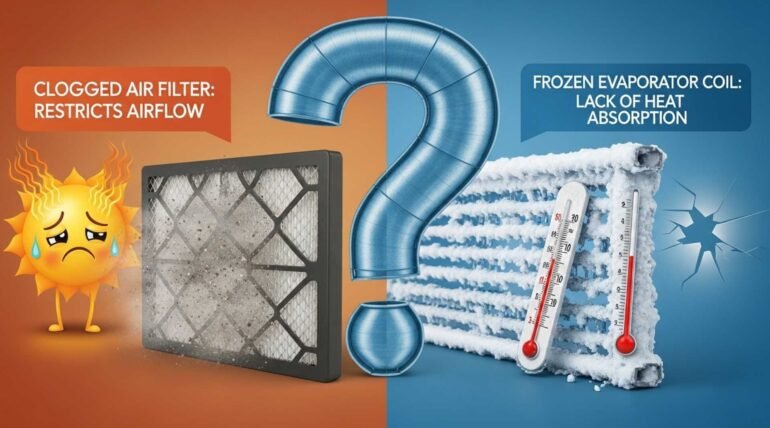
A severely clogged air filter is the single most common cause of an AC running without effective cooling — and it is 100% preventable. When the filter becomes packed with dust, pet hair, and debris, airflow across the evaporator coil drops dramatically. The coil cannot absorb heat efficiently. In severe cases, the restricted airflow causes the evaporator coil to drop below freezing and ice over completely — at which point no cooling happens at all regardless of how long the system runs.
Pull your filter out now and hold it up to a light source. If you cannot see light through it, it needs to be replaced immediately. In Los Angeles — particularly in dusty inland communities like Chatsworth, Granada Hills, Porter Ranch, and Reseda — filters should be replaced every 30 days during peak season, not every 90 days as the packaging often suggests.
After replacing a severely clogged filter, if the evaporator coil has iced over, turn the system to FAN ONLY mode for 2 to 3 hours to allow the ice to melt before switching back to cooling mode. Running a frozen coil in cooling mode prolongs the problem and risks compressor damage.
3. Condenser Unit Blocked or Dirty Outdoors
Your outdoor condenser unit works by releasing the heat extracted from inside your home into the outside air. If the condenser coil is caked with dirt, leaves, cottonwood seeds, or debris, it cannot release heat efficiently. The refrigerant returns to the indoor unit still carrying heat, and the system cannot cool the air properly.
Walk outside and inspect the unit. There should be a minimum of two feet of clearance on all sides. If debris has accumulated on the coil fins — the thin metal fins surrounding the unit — turn the system off and gently rinse the exterior coil with a garden hose from the inside out. Do not use a pressure washer — the fins are delicate and easily damaged. Do not attempt to clean the interior components yourself.
In the San Fernando Valley, cottonwood tree seeds in spring and dry dusty conditions in late summer are particularly common causes of condenser coil buildup that homeowners in Woodland Hills, Tarzana, and Encino should check seasonally.
4. Tripped Circuit Breaker — Compressor Off, Fan On
Your AC system typically runs on two separate circuits — one for the indoor air handler and fan, and one for the outdoor compressor. If the compressor’s circuit trips, the indoor fan continues to blow but the outdoor unit stops running. The result is air circulating through your home without any cooling happening — exactly the symptom of “running but not cooling.”
Go to your electrical panel and look for any breakers in the tripped position — usually sitting between ON and OFF. Reset it fully to OFF first, then back to ON. If the breaker trips again immediately or repeatedly, do not keep resetting it. A breaker that trips repeatedly is protecting your system from a genuine electrical fault — call a licensed technician to diagnose the underlying cause before further damage occurs.
Issues That Require a Licensed HVAC Technician
5. Low Refrigerant Due to a Leak
Refrigerant is the substance that makes cooling physically possible — it absorbs heat from your indoor air at the evaporator coil and carries it outside to be released at the condenser. A properly functioning AC system does not consume refrigerant. If your system is low on refrigerant, it has a leak somewhere in the refrigerant circuit.
Signs of low refrigerant include warm air from supply vents despite the system running, ice forming on the refrigerant lines near the indoor unit, a hissing or bubbling sound near the indoor or outdoor unit, and significantly longer run times without achieving the set temperature.
Important: It is illegal in California for an unlicensed person to purchase or handle refrigerant. Do not attempt to add refrigerant yourself. A licensed HVAC technician must locate and repair the leak first — adding refrigerant to a leaking system without fixing the leak is both ineffective and against EPA regulations. Repair costs for a refrigerant leak typically run $300 to $1,500 depending on leak location and severity.
6. Frozen Evaporator Coil
The evaporator coil inside your air handler can freeze solid under the right conditions — most commonly caused by restricted airflow from a clogged filter, low refrigerant, or a failing blower motor. When the coil freezes, it becomes encased in ice and can no longer absorb heat from the air passing over it. The system runs continuously but delivers no cooling.
You can often identify a frozen coil by checking the refrigerant lines running from the outdoor unit to the indoor unit — if the larger insulated line is frosted or iced, the coil is likely frozen. You may also notice water pooling around the indoor unit as the ice melts during off cycles.
The immediate action is to turn the system off and run the fan only for 2 to 4 hours to allow complete thawing. However, this addresses the symptom — not the cause. A technician needs to identify why the coil froze in the first place to prevent recurrence.
7. Failed Capacitor
Capacitors are small cylindrical components that provide the electrical boost needed to start and run the compressor and condenser fan motors. They are one of the most commonly failed AC components — particularly in Los Angeles, where high ambient temperatures in the equipment cabinet during summer put significant thermal stress on capacitors.
A failed start capacitor prevents the compressor or fan motor from starting at all. A failed run capacitor causes the motor to run inefficiently, drawing more current, generating more heat, and delivering less cooling. The classic symptom is a system where you hear the indoor fan running and the outdoor unit humming but not starting properly — sometimes accompanied by a single click followed by nothing from the outdoor unit.
Capacitor replacement is a relatively inexpensive repair — typically $150 to $400 including labor — but must be performed by a licensed technician. Capacitors store a significant electrical charge even when the system is off and can cause serious injury if handled incorrectly.
8. Leaky or Blocked Ductwork
If your system is cooling the air correctly but that cooled air is escaping through leaks in the ductwork before reaching your living spaces, the result is a house that stays warm despite the system running normally. Studies consistently show that the average home loses 20 to 30% of conditioned air through duct leaks — and in older Los Angeles homes where ductwork runs through hot attic spaces, this figure is often higher.
Signs of duct leakage include rooms that are consistently harder to cool than others, visible gaps or disconnections in accessible ductwork in the attic or crawlspace, and a system that seems to run constantly without achieving the set temperature even though the system itself tests fine. A technician can perform a duct leakage test to quantify the loss and recommend repair or replacement.
For a broader look at how ductwork affects your system’s performance and indoor air quality, see our post on How Proper Maintenance Improves Indoor Air Quality and Energy Efficiency.
9. Failing or Failed Compressor
The compressor is the heart of your AC system — it pressurizes the refrigerant and drives the entire cooling cycle. A failing compressor may allow the system to run while producing significantly reduced cooling capacity. A failed compressor stops the cooling cycle entirely while the fan continues to operate normally, producing the classic “running but not cooling” symptom.
Compressor failure is the most expensive AC repair — replacement costs typically run $1,500 to $3,000 for the compressor alone, not including labor. On any system over 10 years old, a compressor failure is almost always the trigger to evaluate full system replacement rather than repair, since the rest of the system’s components are at similar stages of wear. For guidance on that decision, see our post on Why Your Old AC Is Costing You More Than a Brand New One Would.
Quick Diagnosis Guide: What to Check and When to Call
| Symptom | Most Likely Cause | DIY Check? | Action |
|---|---|---|---|
| Air blowing but not cold, thermostat set correctly | Clogged filter or low refrigerant | Check filter — yes. Refrigerant — no | Replace filter first; call tech if no improvement |
| Fan running, outdoor unit not running | Tripped breaker or failed capacitor | Check breaker — yes. Capacitor — no | Reset breaker once; call tech if it trips again |
| Ice visible on refrigerant lines or indoor unit | Frozen evaporator coil | Partial — turn off, run fan only | Thaw for 2–4 hours then call tech to find root cause |
| Hissing or bubbling sound near unit | Refrigerant leak | No | Call licensed technician immediately |
| Some rooms cool, others warm | Duct leaks, blocked vents, or sizing issue | Check vents for obstructions — yes | Clear vents; call tech for duct inspection |
| System running constantly, never reaches set temp | Low refrigerant, undersized system, or duct loss | No | Call licensed technician for full diagnostic |
| Outdoor unit humming but not starting | Failed capacitor or compressor issue | No | Call licensed technician — do not keep attempting to start |
| Warm air only, system over 12 years old | Compressor decline or refrigerant leak | No | Call technician — evaluate repair vs replace |
Typical Repair Costs in Los Angeles for Common Causes
| Issue | Typical Repair Cost (LA Market 2026) | DIY Possible? |
|---|---|---|
| Air filter replacement | $10–$30 (DIY) / $50–$100 (technician visit) | Yes |
| Capacitor replacement | $150–$400 including labor | No — electrical hazard |
| Refrigerant leak repair + recharge | $300–$1,500 depending on leak location | No — requires EPA certification |
| Condenser coil cleaning (professional) | $100–$300 | Partial — exterior rinse only |
| Thermostat replacement | $150–$450 including smart thermostat | Possible for basic models |
| Duct sealing / repair | $500–$2,500 depending on scope | No |
| Compressor replacement | $1,500–$3,000+ including labor | No — evaluate replacement instead |
| Full system replacement | $7,500–$15,000 (heat pump) — LADWP rebate up to $2,500/ton | No |
For a detailed breakdown of HVAC repair and replacement costs specific to Los Angeles, see our guide on Los Angeles HVAC Repair Costs.
When “Running But Not Cooling” Means It Is Time to Replace
Not every AC running without cooling is a repair situation. If your system is over 12 years old, has needed multiple repairs in recent seasons, and is now failing to cool effectively, the most financially sound decision is often full replacement rather than another repair cycle. Every repair on an aging system buys diminishing time before the next component fails.
A heat pump replacement at this stage also unlocks the LADWP rebate of up to $2,500 per ton — significantly offsetting the replacement cost while giving you a system that handles both heating and cooling. For a full look at what replacement costs and what rebates are available, see: Heat Pump Installation in Los Angeles: Costs, Rebates & Everything Homeowners Need to Know.
For a full checklist of warning signs your system is approaching end of life, see: 5 Warning Signs Your AC Needs Repair Before It Breaks Down Completely.
Frequently Asked Questions
Why is my AC running but not cooling the house at night?
If cooling is poor at night specifically, the most common causes in Los Angeles are a refrigerant issue causing the system to lose capacity after extended daytime running, or a thermostat that is not dropping the setpoint in the evening. Check thermostat scheduling first. If nighttime temperatures are still warm and your system ran all day, a low-refrigerant condition often becomes more apparent after extended operation.
Can I add refrigerant to my AC myself?
No. In California, purchasing or handling refrigerant requires EPA Section 608 certification. It is illegal for unlicensed individuals to buy or add refrigerant. Beyond legality, adding refrigerant without fixing the underlying leak is ineffective — the system will lose the charge again and the leak will continue to damage components.
My AC runs all day but never reaches my set temperature. What is wrong?
This is a classic symptom of one of four things: low refrigerant, a significantly clogged or dirty condenser coil, ductwork losing too much conditioned air before it reaches living spaces, or a system that is undersized for your home. During a Los Angeles heat wave when outdoor temperatures exceed 100°F, even a properly functioning system may struggle to maintain 72°F — most residential systems are designed to maintain a 20 to 25°F temperature differential from outside, meaning a 75°F indoor temperature on a 100°F day is at or near the design limit.
How long does it take for a frozen AC coil to thaw?
With the system switched to FAN ONLY mode, a frozen evaporator coil typically thaws completely in 2 to 4 hours. Do not run the system in cooling mode with a frozen coil — doing so strains the compressor and can cause permanent damage.
AC Not Cooling? TOP AC Inc. Responds Fast Across the San Fernando Valley
At TOP AC Inc., we know that an AC running without cooling in a Los Angeles summer is not a problem that can wait until next week. Our licensed technicians are available 24/7 for emergency diagnostic calls and same-day service across the San Fernando Valley and surrounding communities.
We diagnose accurately, we quote honestly, and we never recommend a repair or replacement that is not genuinely in your interest. We serve homeowners throughout a 10-mile radius of our Canoga Park headquarters, including:
- Canoga Park 91303, 91304
- Woodland Hills 91364, 91367
- West Hills 91307, 91308
- Winnetka 91306
- Chatsworth 91311
- Northridge 91324, 91325, 91326
- Granada Hills 91344
- Porter Ranch 91326
- Reseda 91335
- Tarzana 91356, 91357
- Encino 91316, 91436
- Sherman Oaks 91403, 91423
📞 Call us at (855) 999-8672
🌐 top-ac.com
📍 21201 Victory Blvd, Suite 102, Canoga Park, Los Angeles, CA 91303
🕐 Available 24/7 — Emergency AC Repair, Residential & Commercial
Call now and a licensed technician will diagnose your system the same day — so you are not spending another night in a hot house.