
April 25, 2026
How Long Does an AC Unit Last in Los Angeles?
If you are an Los Angeles homeowner asking how long does an AC unit last in Los Angeles, the honest answer is: shorter than the national average — and for specific reasons tied directly to Southern California’s climate, geography, and the way most LA homes run their systems.
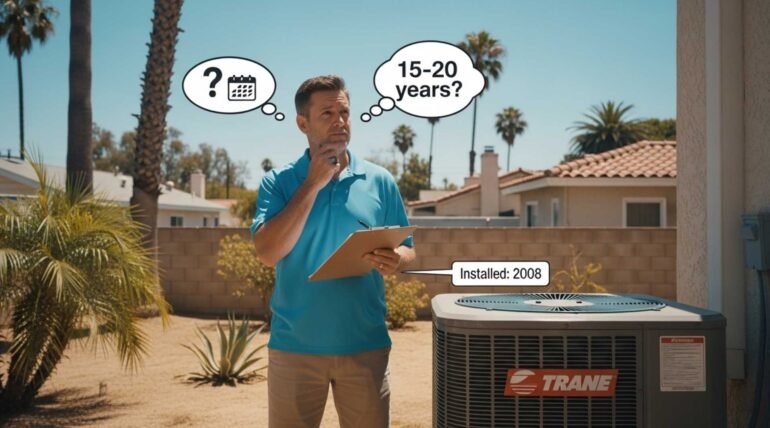
Nationally, a well-maintained central AC unit lasts 15 to 20 years. In Los Angeles, the realistic lifespan for most homeowners falls between 12 and 17 years — and for homes in coastal communities, it can be as few as 10 to 14 years. Understanding why — and what you can do about it — is the difference between a system that hits 17 years and one that fails at 11.
This guide covers the real lifespan numbers by system type and LA neighborhood, the specific factors that shorten AC life in Southern California, the warning signs your system is approaching end of life, and how to decide between repair and replacement when the time comes.
AC Lifespan in Los Angeles by System Type
Not all AC systems are created equal when it comes to longevity. Here are realistic lifespan ranges for the most common system types in Los Angeles residential properties:
| System Type | National Average Lifespan | Realistic LA Lifespan | Key Lifespan Factor |
|---|---|---|---|
| Central ducted AC (split system) | 15–20 years | 12–17 years | Extended cooling season, heat stress on compressor |
| Ductless mini-split | 15–20 years | 15–20 years | Less duct loss, inverter-driven compressors more durable |
| Heat pump (air-source) | 10–16 years | 12–18 years | LA’s mild winters reduce heating strain significantly |
| Coastal property AC (any type) | 15–20 years | 10–14 years | Salt air corrosion accelerates coil and component deterioration |
| Window unit | 5–10 years | 5–8 years | Continuous seasonal use reduces lifespan toward lower end |
One important note on heat pumps: Los Angeles’s mild winters — where temperatures rarely drop below 40°F — are actually ideal for heat pump longevity. Unlike colder climates where heat pumps work hard through winter defrost cycles, an LA heat pump spends most of its year in cooling mode at moderate loads. This extends operational life compared to the national average.
Why AC Units Don’t Last as Long in Los Angeles as in Other Cities
LA homeowners often assume their system should match the 15–20 year national lifespan on the label. It usually does not — and there are concrete reasons why.
1. The Cooling Season Never Fully Ends
In much of the United States, air conditioners sit idle for five or six months each winter. In Los Angeles, that rest period barely exists. Many homeowners in the San Fernando Valley, Inland communities, and even coastal areas run their AC systems from April through October — and during periods like the October heat waves that regularly push temperatures past 90°F in communities like Chatsworth, Northridge, and Woodland Hills, November use is common too.
More operational hours per year means more wear on every moving part — the compressor, condenser fan motor, capacitors, and contactors. A system that runs 2,000 hours per year wears out roughly twice as fast as one that runs 1,000 hours per year, regardless of what the manufacturer’s lifespan estimate says.
2. Heat Waves Put Extreme Stress on Compressors
The compressor is the single most expensive component in your AC system — and it is the one most damaged by extreme heat. When outdoor temperatures climb above 95°F, your system’s condenser struggles to reject heat efficiently. The compressor works harder, runs longer, and generates more internal heat. Repeated exposure to temperatures of 100°F and above — which communities throughout the San Fernando Valley and Inland areas regularly experience — accelerates compressor wear faster than any other operating condition.
When a compressor fails on a system that is over 10 years old, replacement costs typically run $1,500 to $3,000 for the compressor alone — often approaching or exceeding the threshold where full system replacement makes more financial sense.
3. Coastal Salt Air Corrosion
For homeowners in communities closer to the coast, salt particles carried in the marine layer settle on outdoor condenser coils, electrical connections, and metal components. Over time, this salt accelerates corrosion — particularly on aluminum fins and copper tubing. A system that might last 17 years in Northridge may only last 11 to 13 years in a coastal community exposed to regular salt air, without additional protective measures like coil coatings and more frequent rinsing.
4. Dust and Air Quality in Inland Valleys
Communities like Chatsworth, Granada Hills, Porter Ranch, and Reseda — further from the coast and more exposed to dry, dusty air — face a different challenge. Airborne dust clogs air filters faster, accumulates on evaporator and condenser coils, and restricts airflow. Restricted airflow forces the system to work harder to move the same volume of air, increasing strain on the blower motor and compressor. Homes in dusty inland areas should change filters every 30 days rather than the standard 60 to 90 days.
5. Poor Original Installation
The single biggest predictor of AC lifespan — more than brand, more than climate — is the quality of the original installation. A system that is oversized for the home short-cycles, meaning it turns on and off too frequently without completing full cooling cycles. Short-cycling is extremely hard on compressors and dramatically shortens system life. A system that is undersized runs continuously trying to keep up, generating the same problem through overwork rather than rapid cycling.
A proper installation requires a Manual J load calculation specific to your home’s square footage, insulation, ceiling height, window area, and orientation. Any contractor who sizes your system based on square footage alone — without a formal calculation — is taking a shortcut that will cost you years of system life.
How LA’s Microclimates Affect AC Lifespan by Neighborhood
| Neighborhood / Area | Primary Lifespan Challenge | Expected Lifespan Impact | Key Maintenance Priority |
|---|---|---|---|
| San Fernando Valley (Canoga Park, Northridge, Reseda, Tarzana) | Extreme summer heat, long cooling season | 12–16 years typical | Annual tune-up before summer, compressor checks |
| Chatsworth, Porter Ranch, Granada Hills | Dust, dry air, heat waves above 100°F | 11–15 years typical | Monthly filter changes, coil cleaning |
| Woodland Hills, West Hills, Winnetka | Heat corridor — among hottest in LA County | 12–15 years typical | Shade for outdoor unit, refrigerant checks |
| Encino, Sherman Oaks, Tarzana | Moderate valley heat, older housing stock with aged systems | 13–17 years typical | Duct inspection, system sizing review |
| Coastal-adjacent areas | Salt air corrosion on coils and connections | 10–14 years typical | Annual coil rinse, corrosion-resistant coatings |
Warning Signs Your AC Is Approaching End of Life
Your system will usually give you clear signals before it fails completely. Catching these early gives you time to plan a replacement on your schedule — not in an emergency during a July heat wave.
Age Over 12 Years Combined with Any Repair Need
The industry standard guidance is the 50% rule: if a repair costs more than 50% of the price of a new system and your unit is over 10 years old, replacement is almost always the smarter financial decision. A 12-year-old unit that needs a $1,800 compressor repair on a system worth $4,000 new is a textbook case for replacement rather than repair.
Rising Energy Bills Without a Change in Usage
As AC components age and lose efficiency, the system consumes more electricity to deliver the same cooling. If your summer utility bills have been climbing year over year without a change in how you use your system, declining efficiency is likely the cause. Modern high-efficiency systems with SEER2 ratings of 18 or above can reduce cooling costs by 30 to 40% compared to a 12-year-old unit rated at 13 SEER.
Frequent Repair Calls
One repair every few years is normal. Two or more repair calls in a single season — particularly if they involve different components each time — signals that the system is entering a general decline phase where multiple parts are failing simultaneously. At this stage, each repair is buying diminishing time before the next failure.
Refrigerant Type: R-22 Systems
If your AC system uses R-22 refrigerant (also called Freon), it was manufactured before 2010. R-22 was phased out by the EPA and is no longer produced in the United States. While existing R-22 systems can still be serviced with reclaimed refrigerant, availability is limited and costs are high. An R-22 system still operating in 2026 is at minimum 16 years old and almost certainly approaching end of life on both age and refrigerant grounds. For more on refrigerant changes and their impact on older systems, see our guide on Why Your Old AC Is Costing You More Than a Brand New One Would.
Uneven Cooling or Inability to Keep Up During Heat Waves
A system that struggles to maintain your set temperature when outdoor temperatures exceed 95°F — and particularly one that used to handle those conditions without issue — is showing signs of declining capacity. This is often the compressor losing efficiency or refrigerant levels being low due to a slow leak. Both are expensive repairs that, on an aging system, frequently signal replacement is the better investment.
For a full checklist of warning signs, see: 5 Warning Signs Your AC Needs Repair Before It Breaks Down Completely.
Repair vs. Replace: How to Make the Decision
| Situation | Recommended Action | Reasoning |
|---|---|---|
| System under 10 years old, single repair under $800 | Repair | System has remaining life; repair cost is proportionate |
| System 10–12 years old, repair cost $800–$1,500 | Evaluate carefully — consider replacement | Apply 50% rule; get replacement quote for comparison |
| System over 12 years old, any repair over $1,000 | Replace | Repair buys limited time before next failure on aging system |
| System uses R-22 refrigerant, any repair needed | Replace | R-22 cost and availability make repair increasingly uneconomic |
| System failing during heat wave, under 10 years old | Emergency repair | System has remaining life; emergency repair justified |
| Multiple repairs in one season, any age | Replace | Pattern indicates general system decline, not isolated issue |
How to Maximize Your AC System’s Lifespan in Los Angeles
The difference between a system that reaches 12 years and one that reaches 17 years in the LA climate is almost entirely determined by maintenance habits. Here is what actually makes a measurable difference:
- Annual professional tune-up in spring: Schedule before the summer cooling season begins — March or April is ideal. A tune-up checks refrigerant levels, cleans coils, inspects electrical connections, lubricates moving parts, and identifies developing issues before they become expensive failures. For what a professional inspection covers, see our AC Maintenance Tips Before Summer in Los Angeles.
- Filter changes every 30 days in dusty areas, every 60 days elsewhere: A clogged filter is the most common cause of preventable AC problems — it restricts airflow, overworks the blower motor, freezes the evaporator coil, and strains the compressor. This is the single easiest maintenance task with the highest return.
- Keep the outdoor unit clear: Maintain at least two feet of clearance around the condenser unit. Remove leaves, trim back shrubs, and rinse the coil with a garden hose at the start of each season to remove accumulated dust and debris.
- Shade the outdoor unit where possible: An outdoor unit in direct afternoon sun in the San Fernando Valley in July is operating under significantly more thermal stress than one in shade. Strategic landscaping or a shade structure (never an enclosure that restricts airflow) can meaningfully reduce compressor heat load.
- Install a smart thermostat: Setting the thermostat 2 to 3 degrees higher when the home is unoccupied reduces runtime by 15 to 20%, directly reducing cumulative wear on the compressor and fan motors.
For a full seasonal maintenance guide, see: How Seasonal Tune-Ups Can Prevent Major Repairs and System Failures.
Frequently Asked Questions
How long does a central AC unit last in Los Angeles?
In Los Angeles, a well-maintained central AC system typically lasts 12 to 17 years. The national average of 15 to 20 years is shortened in LA primarily due to the longer cooling season, extreme heat wave temperatures in the San Fernando Valley and inland communities, and — for coastal properties — salt air corrosion on outdoor components.
How do I know if my AC is too old to repair?
Apply the 50% rule: if the repair cost exceeds 50% of the replacement cost and your system is over 10 years old, replacement is generally the smarter financial decision. Also factor in refrigerant type — R-22 systems are at minimum 16 years old and the refrigerant itself is increasingly scarce and expensive.
Does a heat pump last longer than a regular AC in Los Angeles?
In Los Angeles’s mild climate, heat pumps can actually outlast standalone AC units because the mild winters reduce the heating-season strain that limits heat pump life in colder climates. A well-maintained heat pump in the LA area can realistically achieve 15 to 18 years of service life.
What is the best time of year to replace an AC in Los Angeles?
Late winter and early spring — February through April — is the best time to replace an AC in Los Angeles. Contractor availability is highest, pricing is often more competitive during off-peak months, and you will have your new system in place before the heat season begins rather than scrambling to get installation during peak summer demand.
TOP AC Inc. — AC Replacement and Maintenance Serving the San Fernando Valley and Surrounding Communities
At TOP AC Inc., we help Los Angeles homeowners make informed decisions about when to repair, when to replace, and which system is right for their home and budget. Whether your system is showing early warning signs or has already failed, our licensed technicians provide honest assessments — no upselling, no unnecessary replacements, no pressure.
We serve homeowners throughout a 10-mile radius of our Canoga Park headquarters, including:
- Canoga Park 91303, 91304
- Woodland Hills 91364, 91367
- West Hills 91307, 91308
- Winnetka 91306
- Chatsworth 91311
- Northridge 91324, 91325, 91326
- Granada Hills 91344
- Porter Ranch 91326
- Reseda 91335
- Tarzana 91356, 91357
- Encino 91316, 91436
- Sherman Oaks 91403, 91423
📞 Call us at (855) 999-8672
🌐 top-ac.com
📍 21201 Victory Blvd, Suite 102, Canoga Park, Los Angeles, CA 91303
🕐 Available 24/7 — Residential & Commercial
Call today for a free honest assessment of your system’s remaining life — and a no-obligation replacement quote if the time is right.