
June 28, 2026
Your Energy Bill Just Went Up Again — Here Is What an HVAC Tune-Up Actually Fixes
If your summer electricity bill has been climbing for the third year in a row and you cannot point to anything you have changed — no new appliances, no different habits, nothing obvious — there is a good chance the answer is sitting in your attic or backyard, quietly losing efficiency one degraded component at a time. An HVAC tune-up cost in Los Angeles runs $85 to $250 for most homes — and yet a significant share of homeowners either skip it entirely or treat it as a vague “check-up” without understanding what it actually does for their system, their bills, and their bottom line.
This guide breaks down exactly what a real HVAC tune-up covers point by point, what each step actually prevents, what it costs in the current Los Angeles market, and how to tell a legitimate comprehensive tune-up from a $79 promotional visit that leaves real problems undiscovered.
What an HVAC Tune-Up Costs in Los Angeles in 2026
Pricing in the LA market falls into a fairly predictable range, with variation driven by system type, accessibility, and whether the visit is a basic check or a comprehensive inspection.
| Service Type | Typical Cost — LA 2026 | What’s Included |
|---|---|---|
| Basic tune-up | $75 – $150 | Filter check, basic cleaning, visual inspection |
| Standard central AC tune-up | $85 – $200 | Most common service level for LA homes — full system inspection |
| Comprehensive / premium tune-up | $200 – $550 | Deeper diagnostics, coil cleaning, full electrical testing |
| Heat pump tune-up | $80 – $350 | Additional checks for reversing valve and aux heat function |
| Mini-split tune-up (per zone) | $200 – $400 | Indoor and outdoor unit service for ductless systems |
| Ventilation / ductwork inspection (add-on) | $80 – $450 | Additional service if airflow or duct issues are suspected |
| Annual maintenance plan (1–2 visits/year) | $150 – $500/year | Often includes priority scheduling and repair discounts |
Labor in Los Angeles runs $75 to $150 per hour — among the higher end nationally due to the city’s cost of living and elevated demand during peak cooling season. Several factors push individual quotes within these ranges: system age (older systems take longer to service and may need harder-to-find parts), accessibility (a unit in a tight attic or behind overgrown landscaping adds labor time), and refrigerant type (R-22 systems requiring a check or top-off carry significantly higher cost exposure than R-410A or newer refrigerants).
A note on rock-bottom pricing: Promotional tune-ups advertised at $49 to $79 are common in the LA market and are not necessarily a scam — but they are almost always a basic visual check, not a comprehensive inspection. The risk is real: a surface-level visit can miss developing problems that a thorough inspection would catch, leading to an unexpected major repair during the next heat wave. Understand what is actually included before assuming a low price and a comprehensive tune-up are the same thing.
What a Real HVAC Tune-Up Actually Includes
A legitimate, comprehensive tune-up is a systematic inspection and service process — not a quick glance and a filter swap. Here is what each component of a proper tune-up actually covers, broken down by what it inspects and what failure it is designed to catch before it becomes an expensive emergency.
1. Air Filter Inspection and Replacement
The technician checks your filter’s condition and replaces it if needed — typically included in the base price for a standard filter. A clogged filter is the single most common cause of restricted airflow, frozen evaporator coils, and overworked blower motors. This is the simplest step in the entire process and also the one most likely to prevent a costly mid-summer service call. For LA pet households, this step matters even more — see our guide on Indoor Air Quality for Pet Owners in Los Angeles.
2. Thermostat Calibration and Electrical Controls Check
The technician verifies your thermostat is reading temperature accurately and communicating correctly with your system. A miscalibrated thermostat can cause your system to run longer than necessary or fail to reach your actual desired temperature — both of which directly inflate your energy bill without any visible system fault. If you have a smart thermostat, this is also when proper scheduling and heat pump configuration (if applicable) gets verified. For more on smart thermostat setup specific to LA homes, see: Smart Thermostat Installation in Los Angeles.
3. Refrigerant Level Check and Leak Inspection
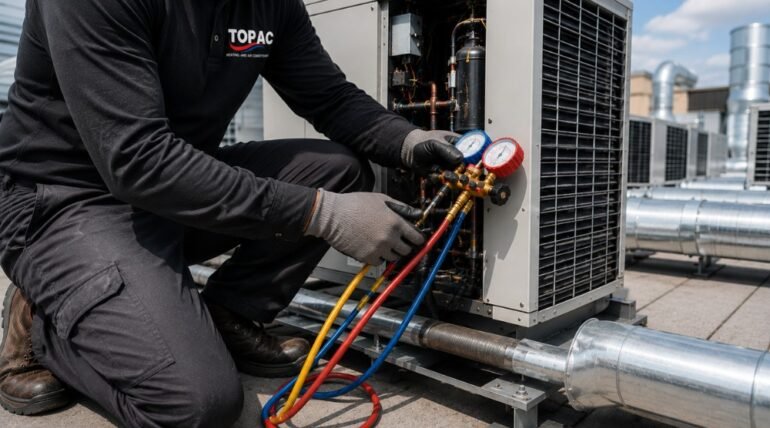
The technician measures refrigerant pressure against manufacturer specifications. Refrigerant does not deplete during normal operation — if levels are low, there is a leak somewhere in the system. Catching a small leak during a routine tune-up, before it becomes a major leak that causes the system to fail entirely, is one of the highest-value outcomes of regular maintenance. This is especially critical for older systems still running R-22, where refrigerant costs have escalated to $80 to $150 per pound. For the full picture on R-22 systems specifically, see: R-22 Refrigerant Phase Out: What Los Angeles Homeowners Need to Know.
4. Electrical Component Inspection — Capacitors, Contactors, Wiring
Capacitors and contactors are the most common failure points in any AC system, and they degrade faster under sustained high-heat operation — exactly the conditions Los Angeles summers create. A technician will test capacitor capacitance against rated specifications, inspect contactors for pitting or arcing damage, and check all electrical connections for looseness or corrosion. A capacitor on the verge of failure can be identified and replaced for $150 to $400 during a routine visit — versus an emergency after-hours repair during a heat wave when the same component fails completely.
5. Condenser and Evaporator Coil Inspection
The outdoor condenser coil and indoor evaporator coil are inspected for dirt, debris, and corrosion. A dirty condenser coil cannot reject heat efficiently, forcing the compressor to work harder and consume more electricity to deliver the same cooling output. In Los Angeles’s dustier inland communities — Chatsworth, Northridge, Granada Hills, Porter Ranch — coil buildup happens faster than in coastal areas, making this inspection step particularly important. Coil cleaning, when needed, is often available as an add-on within the premium tune-up tier.
6. Condensate Drain Inspection and Flush
The drainage system that removes moisture extracted from the air during cooling is inspected and flushed if needed. A clogged condensate drain can cause water damage to ceilings and walls, trigger a safety switch that shuts the entire system down, or create conditions for mold growth inside the air handler. This is a frequently overlooked component that causes a disproportionate number of emergency calls when neglected.
7. Blower Motor and Fan Inspection
The technician inspects the blower motor and fan assembly for wear, lubricates moving parts where applicable, and verifies proper airflow output. A blower motor under strain from accumulated debris or worn bearings consumes more electricity and is at higher risk of complete failure — typically a $400 to $900 repair when it does fail unexpectedly.
8. Airflow and Ductwork Assessment
A basic tune-up includes a general airflow check. If something looks concerning — uneven airflow between registers, signs of significant leakage — a more detailed ventilation inspection may be recommended as a separate add-on, typically $80 to $450. Given that many Los Angeles homes lose 20 to 30% of conditioned air through leaky ductwork, this step can reveal an efficiency problem that no amount of equipment maintenance alone will solve. For the full picture on duct condition and what replacement costs, see: How Much Does It Cost to Replace Ductwork in Los Angeles?
9. Safety Controls and Carbon Monoxide Check (Heating Systems)
For systems with a gas furnace component, the technician inspects the heat exchanger for cracks and tests safety controls, including limit switches and flame sensors. A cracked heat exchanger allows carbon monoxide — colorless, odorless, and potentially lethal — to enter the air circulating through your home. This is one of the most safety-critical steps in any heating system tune-up. For more on this specific risk, see: Carbon Monoxide Safety Guide for Gas Furnaces.
How a Tune-Up Pays for Itself: The Real Numbers
A $120 to $200 annual tune-up is genuinely one of the highest-ROI maintenance investments available to a Los Angeles homeowner — provided it is a comprehensive visit, not a surface-level promotional check. Here is how that value breaks down across the categories where neglected maintenance costs homeowners the most:
| What Regular Tune-Ups Prevent | Cost If Skipped | Cost Avoided With Annual Service |
|---|---|---|
| Capacitor failure leading to compressor strain | $1,800 – $3,200 (compressor replacement) | $150 – $400 (capacitor replaced before failure) |
| Undetected refrigerant leak left to worsen | $1,500 – $3,000 (system damage + recharge) | $200 – $1,500 (early leak repair) |
| Dirty coils reducing system efficiency | $960 – $2,160/yr (40% higher electricity use) | $100 – $300 (coil cleaning) |
| Clogged condensate drain causing water damage | $1,000 – $5,000+ (water damage repair) | Included in standard tune-up |
| System failure during a heat wave | Emergency rate $150 – $500/hr + extended wait | Avoided through proactive inspection |
| Premature full system replacement (vs. extended life) | $9,500 – $15,000 (early replacement) | 2–5 additional years of system life |
The pattern across nearly every category is the same: a $100 to $250 annual investment routinely prevents repairs and replacements that cost 5 to 50 times more. This is the math that makes annual maintenance one of the few HVAC-related expenses that pays for itself with near certainty, regardless of how reliable your system has been so far. For the broader picture on how proper maintenance affects both air quality and energy costs, see: How Proper Maintenance Improves Indoor Air Quality and Energy Efficiency.
Why Los Angeles Homes Specifically Need Annual Tune-Ups
The case for annual maintenance is strong everywhere — but several conditions specific to Los Angeles make it more financially significant here than in milder climates.
The Extended Cooling Season Means More Wear, Faster
Most US cities give HVAC systems a multi-month rest each winter. In Los Angeles, systems often run from April through October — 7 to 8 months of active operation. More runtime means components accumulate wear faster, and small developing issues become large issues in a shorter window than the manufacturer’s general lifespan estimates assume. For a full breakdown of how LA’s climate shortens HVAC lifespan, see: How Long Does an AC Unit Last in Los Angeles?
Triple-Digit Heat Events Push Components to Their Limits
San Fernando Valley communities — Northridge, Chatsworth, Canoga Park, Woodland Hills — regularly experience temperatures of 100°F and above during summer heat events, sometimes exceeding 110°F. These conditions place extreme thermal stress on capacitors, compressors, and electrical components. A capacitor that might last several more years in a moderate climate can fail under the cumulative stress of repeated extreme heat exposure — which is precisely why pre-season inspection catches developing failures before they happen mid-heat-wave.
Higher Electricity Rates Amplify Efficiency Losses
LADWP and SCE residential electricity rates are among the highest in the nation. A system running at 30 to 40% reduced efficiency due to dirty coils or a degraded refrigerant charge is not just an abstract inefficiency — it is a direct, measurable monthly cost increase at LA’s elevated electricity prices. The same maintenance neglect that costs a homeowner in a low-rate state $30 extra per month can cost an LA homeowner $80 to $150 extra per month. For more on LA’s energy cost landscape, see: Los Angeles HVAC Energy Savings.
When to Schedule Your Tune-Up
Timing matters as much as the service itself. Scheduling a tune-up in March or April — before the cooling season begins — gives a technician time to identify and address developing issues before your system is under summer load, and avoids the scheduling crunch and emergency-rate pricing that come with summer demand spikes. Homeowners who wait until the first 100°F day to discover their AC will not turn on are competing for the same limited technician availability as everyone else in the San Fernando Valley simultaneously.
For homes with older systems (10+ years), heavy AC usage, or multiple pets generating additional filter and coil load, a second mid-season check in August can catch issues developing under sustained peak-season operation before they become a late-summer emergency. For a complete pre-summer checklist for LA homeowners, see: AC Maintenance Tips Before Summer in Los Angeles and How Seasonal Tune-Ups Can Prevent Major Repairs and System Failures.
Tune-Up vs. Maintenance Plan: Which Makes More Sense?
A single annual tune-up is a sound, transactional investment. A maintenance plan — typically $150 to $500 per year, often including two visits annually (spring and fall) — adds priority scheduling and discounted repair rates on top of the inspection itself. For homeowners with older systems, multiple pets, or properties in the hotter San Fernando Valley corridor where systems work hardest, the maintenance plan structure often delivers better long-term value through the combination of consistent inspection cadence and protected access to service during peak summer demand, when non-plan customers may face longer wait times.
| Factor | Single Annual Tune-Up | Annual Maintenance Plan |
|---|---|---|
| Typical cost | $85 – $250 one-time | $150 – $500/year (1–2 visits) |
| Repair discounts | None typically included | Often 10–20% off repairs |
| Priority scheduling during peak demand | No | Yes — often a key plan benefit |
| Best for | Newer systems, light usage, single-pet or pet-free homes | Systems over 8 years old, heavy usage, multiple pets, hotter inland zones |
Frequently Asked Questions
How much should an HVAC tune-up cost in Los Angeles?
A standard, comprehensive central AC tune-up in Los Angeles runs $85 to $200. Basic visual checks run lower at $75 to $150 but cover less. Premium, diagnostic-heavy tune-ups run $200 to $550. Mini-split systems typically cost $200 to $400 per zone. Be cautious of promotional pricing under $79 — confirm exactly what is included before assuming it matches a standard comprehensive tune-up.
How often should I get an HVAC tune-up in Los Angeles?
At minimum once per year, ideally in March or April before the cooling season begins. Homes with systems over 8 years old, multiple pets, or located in the hotter San Fernando Valley corridor benefit from a second mid-season check in August to catch issues developing under sustained summer load.
Is a $79 promotional AC tune-up worth it?
It depends entirely on what is actually included. A genuine $79 visit that covers filter check, basic cleaning, and visual inspection has real value as a baseline check. The risk is when a promotional price is used to get a technician in the door for an upsell, without performing the deeper diagnostic steps — refrigerant level testing, electrical component testing, coil inspection — that catch developing problems before they fail. Always ask specifically what is included before booking.
What is the difference between an HVAC tune-up and an HVAC inspection?
A tune-up is active maintenance — cleaning, lubrication, filter replacement, and adjustment of your system. An inspection is a diagnostic assessment of your system’s current condition, often required for real estate transactions or insurance purposes, and typically involves more extensive documentation. Standard residential tune-ups run $85 to $250; specialized inspections for escrow or insurance compliance can run $150 to $325 or more depending on documentation requirements.
Will an HVAC tune-up lower my electricity bill?
Yes, if your system has accumulated any of the common efficiency losses a tune-up addresses — dirty coils, low refrigerant, a struggling blower motor, or a miscalibrated thermostat. A properly maintained system can use up to 30% less energy than a neglected one delivering the same cooling output. The savings are most significant for systems that have gone more than 18 months without professional service.
Schedule Your HVAC Tune-Up with TOP AC Inc. — Serving the San Fernando Valley
At TOP AC Inc., our tune-ups are comprehensive, not promotional bait. Every visit includes a full electrical component check, refrigerant level testing, coil inspection, condensate drain service, and thermostat calibration — performed by licensed technicians who know exactly what San Fernando Valley summers do to HVAC systems. We give you a clear written report of what we found, what we did, and what to watch going forward — no surprise upsells, no vague “everything looks fine.”
We serve homeowners throughout a 10-mile radius of our Canoga Park headquarters, including:
- Canoga Park 91303, 91304
- Woodland Hills 91364, 91367
- West Hills 91307, 91308
- Winnetka 91306
- Chatsworth 91311
- Northridge 91324, 91325, 91326
- Granada Hills 91344
- Porter Ranch 91326
- Reseda 91335
- Tarzana 91356, 91357
- Encino 91316, 91436
- Sherman Oaks 91403, 91423
📞 Call us at (855) 999-8672
🌐 top-ac.com
📍 21201 Victory Blvd, Suite 102, Canoga Park, Los Angeles, CA 91303
🕐 Available 24/7 — Residential & Commercial
Schedule your tune-up today — before summer demand makes scheduling harder and pricing higher.