
May 9, 2026
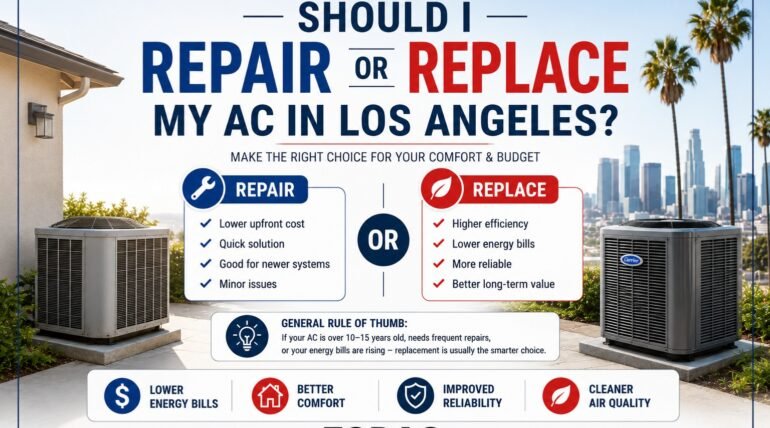
Should I Repair or Replace My AC in Los Angeles?
It is one of the most consequential financial decisions a Los Angeles homeowner makes — and it often arrives at the worst possible moment, in the middle of a July heat wave with a technician standing in your living room giving you a repair quote you were not expecting. Should you repair or replace your AC in Los Angeles? The right answer depends on a set of specific, measurable factors — and this guide walks you through every one of them so you can make the decision confidently, without pressure, and without leaving money on the table.
We cover real 2026 repair and replacement costs specific to the Los Angeles market, the decision frameworks HVAC professionals actually use, the refrigerant factors that changed the math in 2026, and — critically — the rebate opportunity that makes replacement significantly more financially attractive right now than it has been in years.
The Core Decision Tools: Two Rules That Work
Before diving into the specifics, here are the two industry-standard decision frameworks that HVAC professionals use when evaluating repair versus replacement. Neither is sufficient on its own — but together they give you a reliable starting point for any situation.
The 50% Rule
If the cost of the repair exceeds 50% of the cost of a new replacement system, replace rather than repair. The logic is straightforward: spending $2,500 to repair a system worth $5,000 new is economically irrational when you consider that the repaired system still has all its other aging components, is still consuming energy at its old inefficiency level, and will likely require another repair within 1 to 3 years.
The Age-Times-Repair-Cost Rule
Multiply the repair cost by the system’s age in years. If the result exceeds $5,000, replacement is almost always the smarter financial choice. For example: a $800 repair on a 4-year-old system = $3,200 → repair. A $900 repair on an 8-year-old system = $7,200 → lean toward replacement. A $1,200 repair on a 12-year-old system = $14,400 → replace.
This rule captures what the 50% rule misses: the compounding cost risk of repairing an aging system. A repair that seems reasonable in isolation becomes less rational when you factor in that every component in the system is at the same stage of wear — meaning the next failure is not far behind.
Real 2026 Repair Costs in Los Angeles
Understanding whether a repair cost is reasonable requires knowing what repairs actually cost in the LA market. Los Angeles consistently runs at the higher end of national HVAC repair pricing due to elevated labor rates, licensing overhead, and year-round demand for technicians.
| Repair Type | Typical Cost — LA Market 2026 | DIY Possible? | Notes |
|---|---|---|---|
| Diagnostic / service call fee | $89 – $149 (standard hours) / $150 – $250 (after-hours) | No | Applied toward repair cost with most reputable contractors |
| Capacitor replacement | $150 – $400 | No — electrical hazard | Most common repair on systems 7–12 years old |
| Contactor replacement | $150 – $350 | No | Often replaced alongside capacitor |
| Refrigerant leak repair + recharge (R-410A) | $400 – $1,500 | No — EPA certification required | Cost varies significantly by leak location and severity |
| Refrigerant recharge only (R-22 systems) | $800 – $2,500+ | No | R-22 supply shrinking — cost rising year over year |
| Evaporator coil replacement | $900 – $2,200 | No | Labor-intensive — evaluate vs replacement on older systems |
| Condenser coil replacement | $900 – $2,500 | No | Often triggers full outdoor unit replacement instead |
| Blower motor replacement | $400 – $900 | No | Reasonable repair on systems under 10 years old |
| Compressor replacement (in-warranty) | $800 – $1,500 labor only | No | Parts covered under warranty — labor is the cost |
| Compressor replacement (out of warranty) | $1,800 – $3,200 parts + labor | No | On any system over 10 years — evaluate full replacement instead |
| Thermostat replacement (smart) | $150 – $450 installed | Possible for basic models | Worth doing regardless of system age — immediate efficiency gains |
Labor rates in Los Angeles run $100 to $150 per hour for standard-hours HVAC repair work. After-hours emergency calls — evenings, weekends, and holidays — carry a premium that typically adds $50 to $100 per hour on top of standard rates. For a broader overview of what repairs cost across different systems and scenarios, see our detailed guide: Los Angeles HVAC Repair Costs.
Real 2026 Replacement Costs in Los Angeles
| System Type | Installed Cost — LA Market 2026 | LADWP Rebate Available? | Net Cost After Max Rebate (3-ton) |
|---|---|---|---|
| Central AC only (replacing AC, keeping existing furnace) | $5,500 – $10,500 | No (AC-only not eligible) | $5,500 – $10,500 |
| Gas furnace only (replacing furnace, keeping existing AC) | $4,000 – $7,500 | No (gas equipment not eligible) | $4,000 – $7,500 |
| Central AC + Gas furnace (both replaced together) | $9,500 – $16,500 | No (gas equipment not eligible) | $9,500 – $16,500 |
| Ducted heat pump (replaces both AC + furnace) | $9,500 – $15,000 | Yes — up to $2,500/ton | As low as $2,000 – $7,500 after rebate |
| Ductless mini-split heat pump (single zone) | $4,200 – $6,800 | Yes — qualifying models eligible | Varies by tonnage |
The rebate column in this table is the most important number most homeowners overlook when evaluating repair versus replacement. A ducted heat pump replacement that costs $11,500 installed qualifies for up to $7,500 in LADWP rebates on a 3-ton system — bringing the net out-of-pocket cost to approximately $4,000. Compared against a $2,500 compressor repair on a 12-year-old system that will likely need another repair within 2 years, the net-cost replacement path is often more financially rational than it first appears. For the full rebate picture, see: LADWP Heat Pump Rebate 2026: How to Qualify and Maximize Your Savings.
The Refrigerant Factor: Why 2026 Is a Turning Point for Older Systems
Refrigerant type is now one of the most important factors in the repair versus replace decision — and it is one that did not exist as a consideration five years ago.
R-22 Systems (Installed Before 2010)
R-22 refrigerant was phased out by the EPA and is no longer manufactured in the United States. Any system still using R-22 is at minimum 16 years old. The supply of reclaimed R-22 is finite and shrinking — prices have escalated significantly and will continue to do so. A refrigerant recharge on an R-22 system in Los Angeles now costs $800 to $2,500 depending on how much refrigerant the system needs, and that cost will only increase.
The decision framework for any R-22 system is simple: do not invest in significant repairs on any R-22 system. The refrigerant situation alone makes these systems economically unviable beyond basic maintenance. If an R-22 system fails, replacement is the correct answer in virtually every scenario.
R-410A Systems (2010–2024 Installations)
R-410A is still available from existing stockpiles and can be used for recharging systems installed between 2010 and 2024. However, R-410A was designated for phase-down under the American Innovation and Manufacturing Act, and new HVAC equipment sold in 2026 uses next-generation lower-GWP refrigerants such as R-32 or R-454B. R-410A availability is expected to become progressively more constrained over the coming years.
For R-410A systems under 10 years old, repair remains fully viable. For R-410A systems over 12 years old, the combination of age and refrigerant transition risk adds meaningful weight to the replacement argument.
New Refrigerant Systems (2025–2026 Installations)
Systems installed in 2025 or 2026 use refrigerants with a Global Warming Potential (GWP) of 700 or lower — the new EPA standard effective January 1, 2026. These systems are fully current with regulatory requirements and should be repaired as needed throughout their normal lifespan.
The Complete Repair vs. Replace Decision Framework for LA Homeowners
| Your Situation | Recommendation | Key Reasoning |
|---|---|---|
| System under 8 years old, repair under $800, no refrigerant issues | Repair | System has substantial remaining life; repair is proportionate |
| System 8–10 years old, repair $800–$1,500 | Repair — but get replacement quote too | Apply age-times-cost rule; compare 5-year total cost of both paths |
| System 10–12 years old, any repair over $1,000 | Lean strongly toward replacement | 50% rule likely triggered; remaining system life limited |
| System over 12 years old, any significant repair | Replace | Age-times-cost rule almost always exceeds $5,000 threshold |
| System uses R-22 refrigerant, any repair needed | Replace immediately | Refrigerant cost and availability make R-22 systems economically unviable |
| Two or more repairs in one season, any age | Replace | Pattern indicates general system decline — multiple components failing |
| Compressor failed, system out of warranty, over 10 years old | Replace | Compressor cost alone often triggers 50% rule; remaining components at same wear stage |
| System failing, furnace also aging (both over 10 years) | Replace both with heat pump | Single system replaces both; LADWP rebate up to $2,500/ton changes the economics significantly |
| System failing during peak summer, under 10 years old | Emergency repair | System has remaining life; emergency repair justified — schedule full evaluation afterward |
| LADWP customer, system approaching end of life | Replace with heat pump now | Rebate of up to $2,500/ton is active and funded — captures maximum incentive before it changes |
The 5-Year Total Cost Comparison: Repair vs. Replace
The most accurate way to evaluate the repair versus replace decision is to compare total cost over a 5-year horizon — not just the immediate out-of-pocket cost. Here is a worked example using a realistic scenario for a Los Angeles homeowner with a 12-year-old, 3-ton central AC system:
| Cost Item | Repair Path (Keep existing system) | Replace Path (Heat pump, LADWP customer) |
|---|---|---|
| Immediate repair cost (compressor) | $2,200 | — |
| New system installed cost (3-ton heat pump) | — | $11,500 |
| LADWP rebate (3-ton × $2,500) | — | − $7,500 |
| Net replacement cost after rebate | — | $4,000 |
| Estimated additional repairs over 5 years (aging system) | $1,500 – $3,000 | $0 – $500 (new system under warranty) |
| Energy savings vs old system (30–40% efficiency gain) | — | − $2,500 – $4,000 over 5 years |
| Furnace replacement (separate, if furnace also aging) | $4,500 – $7,500 | Already included — heat pump handles both |
| Estimated 5-year total cost | $8,200 – $12,700 | $1,500 – $4,500 |
When the 5-year total cost is calculated honestly — including likely additional repairs on an aging system, separate furnace replacement cost, and energy savings from a modern high-efficiency system — the replace path frequently outperforms the repair path even before rebates are applied. With LADWP rebates, the gap widens significantly.
When Repair Is Clearly the Right Answer
This guide is not a pitch for replacement in every situation. Repair is genuinely the right answer in a number of common scenarios, and an honest contractor will tell you so:
- Your system is under 8 years old and has had no prior significant repair history. A single repair on a young, well-maintained system is straightforward and cost-effective.
- The failed component is minor — a capacitor, contactor, thermostat, or sensor. These are routine wear items on any system and do not indicate general system decline.
- Your system is still under manufacturer warranty. Parts are covered — you pay labor only, which is typically $400 to $800 for most repairs. Always check your warranty status before authorizing any repair.
- You recently replaced your furnace and it is new. Replacing a functional new furnace to install a heat pump does not make financial sense — in this case, repairing the AC or replacing the AC only is the proportionate response.
For more on the specific warning signs that indicate whether your system is approaching the end of its repair window, see: 5 Warning Signs Your AC Needs Repair Before It Breaks Down Completely and Why Your Old AC Is Costing You More Than a Brand New One Would.
What to Do When Your AC Fails During a Los Angeles Heat Wave
Emergency decision-making under heat stress is how most homeowners end up making expensive mistakes — either agreeing to a repair they should not make, or rushing into a replacement without getting the best available pricing. Here is the protocol that protects you:
- Get the system running if possible — check your filter, breaker, and thermostat settings before calling anyone. Simple fixes cost nothing. See our troubleshooting guide: Why Is My AC Running But Not Cooling the House?
- Get a written diagnostic, not a verbal quote. A legitimate HVAC contractor will provide a written diagnosis of what failed and a written quote for the repair. Never authorize repair work based on a verbal estimate alone.
- Ask the technician directly: “Given the age and condition of this system, would you recommend repair or replacement?” An honest contractor will give you a straight answer. One who pushes repair on a 14-year-old system needing a $2,000 compressor is not acting in your interest.
- If replacement is indicated, do not rush it during peak season. Get the system stabilized with a repair if possible, then schedule a replacement consultation during the less pressured off-season if your timeline allows. Planned off-season replacements in LA can save $1,000 to $2,500 compared to emergency peak-season installs.
The 2030 Factor: Why Replacement Timing Matters Beyond Just the Immediate Cost
For Los Angeles homeowners whose AC system is between 8 and 12 years old and facing a significant repair, the California gas furnace sales ban adds a dimension to the decision that did not exist a few years ago. A gas furnace replacement today installs equipment that will become unsaleable in California by 2030. A heat pump replacement today installs equipment that is fully aligned with where California’s HVAC market is heading — and captures available LADWP rebates that will likely be less generous as the 2030 mandate approaches.
For a full analysis of what the 2030 ban means for LA homeowners’ HVAC decisions, see: California Gas Furnace Ban 2030: What Los Angeles Homeowners Need to Know.
Frequently Asked Questions
How do I know if my AC repair is worth it in Los Angeles?
Apply both the 50% rule and the age-times-cost rule. If the repair cost exceeds 50% of replacement cost, or if repair cost multiplied by system age exceeds $5,000, replacement is generally the better financial decision. Also factor in refrigerant type — any R-22 system should be replaced rather than repaired.
Is it better to repair or replace a 10-year-old AC in Los Angeles?
It depends on the repair cost and the system’s history. A minor repair on a 10-year-old system with no prior repair history can be reasonable. A major repair — compressor, coil, or refrigerant system — on a 10-year-old system typically crosses the threshold where replacement makes more financial sense, particularly when LADWP heat pump rebates are factored into the replacement cost.
What is the average cost to replace an AC in Los Angeles in 2026?
Central AC replacement in Los Angeles runs $5,500 to $10,500 for an AC-only system. A ducted heat pump replacing both AC and furnace runs $9,500 to $15,000 installed — but qualifies for LADWP rebates of up to $2,500 per ton, bringing the net cost significantly lower. A 3-ton heat pump at $11,500 installed can net out at approximately $4,000 after the maximum LADWP rebate.
How long does a repaired AC system last in Los Angeles?
A repair extends a system’s operational life, but not indefinitely. On a system over 12 years old, a single repair typically buys 1 to 3 additional years of operation before the next component failure. On a system under 8 years old, a repair typically extends life by 5 to 8 years, bringing the system to its natural end of life.
Does a new AC qualify for rebates in Los Angeles?
A standard central AC replacement does not qualify for LADWP rebates. Heat pump systems — which replace both your AC and furnace in one unit — qualify for LADWP rebates of up to $2,500 per ton for systems meeting minimum efficiency thresholds. This rebate difference is a significant factor in the repair versus replace financial calculation for most LA homeowners.
Get an Honest Repair vs. Replace Assessment from TOP AC Inc.
At TOP AC Inc., we give every customer an honest evaluation — not a sales pitch for the most expensive option. If your system needs a repair, we will tell you, quote it accurately, and fix it properly. If your system is at the point where replacement makes better financial sense, we will walk you through the exact numbers — including what your LADWP rebate would be — so you can make a fully informed decision without pressure.
We are a licensed, insured HVAC contractor serving Los Angeles homeowners 24 hours a day, 7 days a week. We serve homeowners throughout a 10-mile radius of our Canoga Park headquarters, including:
- Canoga Park 91303, 91304
- Woodland Hills 91364, 91367
- West Hills 91307, 91308
- Winnetka 91306
- Chatsworth 91311
- Northridge 91324, 91325, 91326
- Granada Hills 91344
- Porter Ranch 91326
- Reseda 91335
- Tarzana 91356, 91357
- Encino 91316, 91436
- Sherman Oaks 91403, 91423
📞 Call us at (855) 999-8672
🌐 top-ac.com
📍 21201 Victory Blvd, Suite 102, Canoga Park, Los Angeles, CA 91303
🕐 Available 24/7 — Emergency Repair, Replacement & Free Consultations
Call today — we will give you the honest numbers for your specific system and your specific situation, so you can decide with confidence.