
April 24, 2026
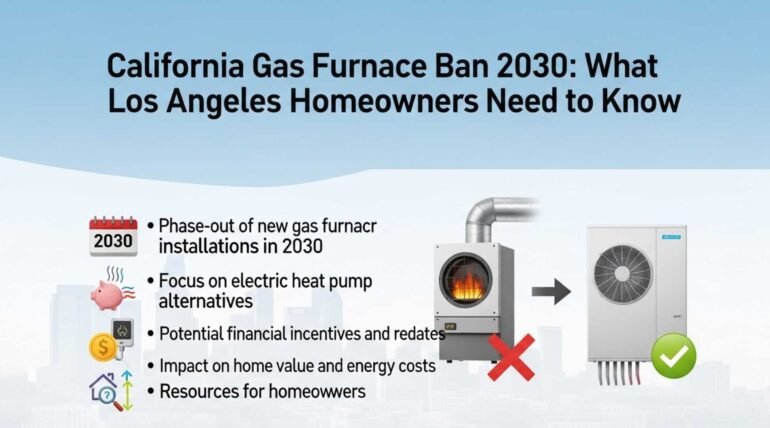
California Gas Furnace Ban 2030: What Los Angeles Homeowners Need to Know
In September 2022, the California Air Resources Board (CARB) voted unanimously to ban the sale of new gas furnaces and gas water heaters statewide beginning in 2030. Since then, the policy has been widely discussed — and widely misunderstood. Homeowners across Los Angeles have questions that range from “Do I have to rip out my furnace right now?” to “Will my house even be legal?” The answers to most of these questions are far less alarming than the headlines suggest.
This guide cuts through the confusion. We explain exactly what the California gas furnace ban 2030 means, what it does not mean, the real timeline for Los Angeles homeowners, and why the window to act now — before 2030 — is genuinely the most financially advantageous position you can be in.
What the California Gas Furnace Ban Actually Says
The California gas furnace ban, adopted by CARB, prohibits the sale of new gas-fired furnaces and gas water heaters beginning in 2030. That is the full scope of the ban. Here is what it does not say:
- It does not require you to remove your existing gas furnace
- It does not require you to replace a functioning gas furnace before it reaches end of life
- It does not apply to gas stoves or cooking appliances at the state level
- It does not make your current home illegal or non-compliant
What it does mean is this: starting in 2030, when your gas furnace fails and needs replacement, a new gas furnace will not be available for purchase in California. Your only replacement options will be zero-emission alternatives — primarily electric heat pumps.
For most Los Angeles homeowners, that transition is coming regardless. A gas furnace installed today has a typical lifespan of 15 to 20 years. A furnace installed in 2010 is already approaching end of life. The question is not whether you will eventually transition — it is whether you do it on your own terms with access to current incentives, or under pressure after a breakdown with no rebates available and potentially high contractor demand.
The Regulatory Timeline: What Is Happening and When
Understanding the actual regulatory sequence helps Los Angeles homeowners plan accurately rather than react to incomplete information.
| Date | What Happens | Who Is Affected |
|---|---|---|
| September 2022 | CARB votes unanimously to ban new gas furnace and water heater sales by 2030 | Statewide — all California residents |
| January 1, 2026 | New construction requires heat pumps for most space and water heating under California Energy Code (Title 24 update) | New builds only — not existing homes |
| January 1, 2029 | Zero-NOx requirement takes effect for residential and commercial furnaces in South Coast AQMD area | South Coast AQMD jurisdiction — includes Los Angeles County |
| January 1, 2030 | Sale of new gas-fired furnaces and water heaters banned statewide | All California homeowners replacing failed equipment |
| 2030 onward | Replacement of failed gas equipment must use zero-emission alternatives | Any homeowner whose gas system fails after ban takes effect |
An important detail specific to Los Angeles: the South Coast AQMD’s zero-NOx furnace requirement takes effect on January 1, 2029 — a full year before the statewide CARB ban. This means Los Angeles County homeowners are on a slightly accelerated timeline compared to the rest of California.
What Happens to Your Existing Gas Furnace
Your existing gas furnace is not affected by the 2030 ban. You can continue to use it, maintain it, and have it repaired for as long as it operates. California’s ban is forward-looking — it targets new sales, not equipment already in service.
However, three scenarios create urgency even for homeowners with functioning equipment:
Scenario 1 — Your furnace fails after 2030. If your gas furnace breaks down after the ban takes effect, you cannot purchase a replacement gas furnace. You will be required to install a heat pump or other zero-emission alternative. If you have not prepared your home’s electrical infrastructure for this transition, you may be facing both a new heat pump and an electrical panel upgrade simultaneously — under time pressure, during heating season, with significantly higher contractor demand than today.
Scenario 2 — Your furnace is aging now. A furnace that is 12 to 15 years old today is likely to fail before or around the 2030 deadline. Replacing it proactively now means you can access current rebates — including LADWP’s up to $2,500 per ton — and schedule the project on your timeline rather than in an emergency.
Scenario 3 — You are selling your home. As the 2030 deadline approaches, buyers and real estate appraisers are becoming increasingly aware of electrification requirements. Homes with modern heat pump systems are positioned ahead of the market shift. An all-electric home may carry a stronger appeal as the ban deadline draws closer and buyer awareness increases.
Why Los Angeles Is Particularly Affected
Los Angeles sits within the South Coast Air Quality Management District — one of the most regulated air quality zones in the United States. The South Coast AQMD has historically led California in implementing stricter appliance standards ahead of statewide timelines, and the 2030 gas furnace ban is no exception.
The zero-NOx furnace rule taking effect in the South Coast AQMD on January 1, 2029 means that gas furnaces sold in Los Angeles County for the final year before the full statewide ban must already be zero-NOx compliant. In practical terms, this further compresses the window for purchasing compliant gas equipment — if gas replacement equipment is even readily available at that stage of the market transition.
The South Coast AQMD’s own analysis found that approximately one-third of projected building-related emissions in the South Coast region could be reduced by 2037 if zero-emission standards were implemented in 2030 for space and water heating. This environmental rationale is one reason the AQMD has been among the most aggressive enforcers of the transition timeline.
For more on how Canoga Park and the broader San Fernando Valley are already moving toward net-zero HVAC standards, see our post on Canoga Park Net Zero HVAC Standards 2026.
Gas Furnace vs. Heat Pump: The Economics in a Post-2030 Los Angeles
The financial comparison between gas furnaces and heat pumps has shifted significantly in favor of heat pumps when the 2030 timeline is factored in.
| Factor | Gas Furnace Installed Today | Heat Pump Installed Today |
|---|---|---|
| Upfront cost (installed, LA) | $4,000–$7,500 (furnace only) | $9,500–$15,000 (replaces both AC + furnace) |
| Available rebates | None for gas equipment | LADWP up to $2,500/ton — no income test |
| Net cost after rebates (3-ton example) | $4,000–$7,500 + separate AC cost | As low as $3,860 after LADWP rebate |
| Replaces air conditioner too? | No — separate AC still needed | Yes — one system for heating and cooling |
| Post-2030 replacement options | No gas replacement available after ban | Heat pump can be replaced with same technology |
| South Coast AQMD zero-NOx compliance | Non-compliant after Jan 1, 2029 | Fully compliant — zero NOx by design |
| System lifespan | 15–20 years | 15–20 years |
For a full side-by-side cost and efficiency analysis, see our detailed guide: Heat Pump vs. Gas Furnace in California: Which Is the Smarter Choice in 2026?
The Rebate Window Is Closing — Here Is Why Timing Matters
One aspect of the 2030 ban that most homeowners do not consider is the effect it will have on the rebate landscape. California’s current incentive programs — including LADWP’s up to $2,500 per ton heat pump rebate — exist specifically because the state needs to encourage voluntary early adoption ahead of the mandate. Once the ban takes effect and heat pumps become the only legal option, the financial incentive for these programs diminishes significantly.
History supports this concern. The HEEHRA program, which offered income-qualified homeowners up to $8,000 for heat pump installations, was fully reserved in California by February 2026 — less than a year after it launched. The GoZero single-family program paused before many homeowners even knew it existed. Programs that appear permanent often are not.
The homeowners who benefit most from California’s electrification push are the ones who act during the incentive window — not those who wait until the mandate forces their hand. For a complete picture of currently available rebates, see: Heat Pump Installation in Los Angeles: Costs, Rebates & Everything Homeowners Need to Know.
Common Myths About the California Gas Furnace Ban
| The Myth | The Reality |
|---|---|
| “I have to remove my gas furnace before 2030” | False. Existing equipment can stay in service until end of life. No removal is required. |
| “My home will be illegal after 2030” | False. Existing gas appliances remain legal. Only new sales are banned. |
| “Gas furnace repair will be illegal after 2030” | False. Maintenance and repair of existing gas furnaces continues to be permitted after the ban. |
| “Heat pumps don’t work in cold weather” | Mostly false for Los Angeles. LA winters rarely drop below 40°F — the range where heat pump efficiency is minimally affected. Modern Hyper-Heat models operate effectively down to -13°F. |
| “This only affects new construction” | False. The 2030 ban applies to replacement equipment in existing homes — not just new builds. |
| “I can just replace my gas furnace with another gas furnace after 2030” | False. After January 1, 2030, new gas furnaces cannot be sold in California. If your furnace fails after that date, your replacement must be zero-emission. |
What Los Angeles Homeowners Should Actually Do Right Now
The right action depends on where your current HVAC equipment is in its life cycle.
If your gas furnace is 12 years old or older: Have it professionally evaluated now. A furnace in this age range is approaching or past the point where repair costs start to outpace the value of keeping it running. Replacing it now with a heat pump gives you access to current LADWP rebates and eliminates the risk of an emergency replacement after the 2030 ban removes gas as an option. For warning signs your system may be near end of life, see our post on 5 Warning Signs Your AC Needs Repair Before It Breaks Down Completely.
If your gas furnace is relatively new (installed within the last 5 years): No immediate action is required. Continue regular maintenance and begin planning your transition strategy for the mid-2020s. Understand that when it eventually needs replacement, a heat pump will be your path forward — and starting to assess your electrical panel capacity now costs nothing and eliminates surprises later.
If your home’s electrical panel is 100 amps or below: A panel upgrade to 200 amps is typically required to support a heat pump system. This upgrade costs $1,200 to $3,500 and is worth planning well in advance of an emergency replacement scenario. Some LADWP programs include panel upgrade incentives — ask your contractor about current availability.
If you have no ductwork: A ductless mini-split heat pump is the most practical replacement path and the technology has matured significantly. These systems qualify for the same LADWP rebates as ducted systems. For more on mini-split options, see: Mitsubishi Mini-Split Installation in Los Angeles.
Frequently Asked Questions
Can I still use my gas furnace after 2030?
Yes. Existing gas furnaces in California can continue to operate after 2030. The ban applies to the sale of new gas furnaces, not to equipment already installed and in service.
Can I get my gas furnace repaired after 2030?
Yes. Repair and maintenance of existing gas furnaces remains permitted after the ban takes effect. Parts availability and contractor specialization in older gas systems may become more limited over time, but there is no regulatory barrier to repair.
What if my gas furnace fails in 2030 or later?
If your gas furnace fails after January 1, 2030, you will not be able to purchase a new gas furnace as a replacement. You will need to install a zero-emission alternative — most likely a heat pump. This is why proactive planning before 2030 is strongly advisable.
Does the ban apply to gas stoves?
The statewide CARB ban covers gas furnaces and gas water heaters only — not gas stoves or cooking appliances. Some individual California cities have passed separate local ordinances restricting gas appliances in new construction, but there is no statewide ban on gas cooking appliances as of 2026.
Does California’s gas furnace ban affect my home insurance or mortgage?
No regulatory change currently affects home insurance or mortgage eligibility based on gas appliance status in existing homes. However, as the 2030 deadline approaches, it is worth monitoring whether lenders or insurers begin adjusting their requirements — particularly for homes in high-climate-risk zones.
Get Ahead of the 2030 Ban with TOP AC Inc. — Serving Los Angeles and the San Fernando Valley
At TOP AC Inc., we have been helping Los Angeles homeowners navigate California’s evolving HVAC regulations since before the 2030 ban was even on most people’s radar. We install heat pumps, ductless mini-splits, and high-efficiency systems that are fully compliant with current and upcoming California standards — and we help you access every available rebate to make the transition as affordable as possible.
Whether your furnace is aging, you want to get ahead of the mandate, or you simply want an honest assessment of your options, our licensed technicians are ready to help. We serve homeowners throughout the San Fernando Valley and surrounding communities, including:
- Canoga Park 91303, 91304
- Woodland Hills 91364, 91367
- West Hills 91307, 91308
- Winnetka 91306
- Chatsworth 91311
- Northridge 91324, 91325, 91326
- Granada Hills 91344
- Porter Ranch 91326
- Reseda 91335
- Tarzana 91356, 91357
- Encino 91316, 91436
- Sherman Oaks 91403, 91423
📞 Call us at (855) 999-8672
🌐 top-ac.com
📍 21201 Victory Blvd, Suite 102, Canoga Park, Los Angeles, CA 91303
🕐 Available 24/7 — Residential & Commercial
Request your free consultation today and find out exactly where your current system stands — and what a heat pump transition would cost your home after available rebates.