

November 23, 2026
How to Replace HVAC Filter in 7 Simple Steps
To learn how to replace HVAC filter, turn off the system, locate the filter slot, match the replacement to the old filter’s size and airflow direction, then slide it in securely. This small task protects airflow, supports cleaner indoor air, and can help your AC or heater run with less strain.
For homeowners in Canoga Park and throughout the San Fernando Valley, filter changes matter most when the weather is working your system hard. Valley heat can keep an AC running for long stretches, while Santa Ana winds and wildfire smoke can bring more dust and particles indoors. A neglected filter is often an easy-to-fix reason for weak airflow, extra dust, or a system that seems louder than usual.
What an HVAC Filter Actually Does
Your HVAC filter captures airborne particles before they reach the indoor equipment. Depending on the filter you choose, that can include dust, lint, pet dander, pollen, and some finer particles. It is not meant to solve every indoor-air concern by itself, but it is the first line of defense for your system and the air moving through your home.
A filter that is too dirty restricts airflow. Your AC or heating equipment then has to work harder to move conditioned air, which can reduce comfort and contribute to unnecessary wear. On the other hand, a filter that is overly dense for a system not designed for it can also limit airflow. The best choice is not always the highest-rated filter on the shelf.
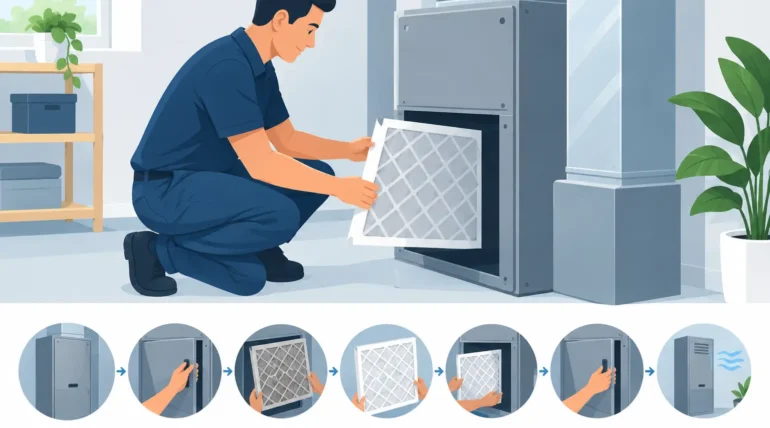
How to Replace HVAC Filter Step by Step
Most standard return-air filters can be changed in a few minutes. If you are unsure whether you have a disposable filter, washable filter, or a larger media cabinet, stop and check the equipment label or your owner’s manual before proceeding.
1. Turn the HVAC system off
Set the thermostat to Off before opening the filter compartment. This keeps the system from pulling loose dust into the equipment while the filter is out. It also makes the task safer around moving blower components.
2. Find the filter location
In many homes, the filter sits behind a large return-air grille in a hallway, ceiling, or wall. It may also be located at the air handler or furnace cabinet, often in a slot beside the blower section.
If you have more than one return grille or more than one system, you may have multiple filters. A two-story home, an addition, or a separate upstairs system can each have its own filter location.
3. Check the old filter’s size
Pull the old filter out carefully and read the size printed on its frame, such as 16 x 25 x 1 or 20 x 20 x 1. Write down the nominal size and thickness before throwing it away.
The actual dimensions can be slightly smaller than the printed size, which is normal. What matters is buying a replacement designed for the same filter slot. Do not force a filter that bows, leaves gaps, or will not slide in easily.
4. Look for the airflow arrow
Every disposable filter should have an arrow on the cardboard frame. The arrow must point in the direction air is traveling, toward the air handler or furnace blower.
At a return grille, the arrow usually points into the wall, ceiling, or equipment. At the equipment cabinet, it normally points toward the blower. If you cannot tell which way air moves, take a photo before removing the old filter or ask a technician during your next maintenance visit.
5. Choose the right MERV rating
MERV is a filter-efficiency rating. A higher number generally captures smaller particles, but can also create more resistance to airflow. For many homes, a pleated filter in the MERV 8 to MERV 11 range is a practical balance between filtration and system performance.
Households with pets, allergies, or frequent dust may benefit from a higher rating if the equipment can support it. Older systems, systems with airflow concerns, and some return setups may need a less restrictive option. This is one of those cases where more filtration is not automatically better.
6. Install the new filter without gaps
Slide the clean filter into place with the arrow facing the correct direction. Close the grille or cabinet panel completely. An improperly seated filter can allow unfiltered air to bypass it, sending dirt into the equipment.
7. Turn the system back on and make a reminder
Restore the thermostat setting and listen for normal operation. Then write the change date on the filter frame or set a phone reminder. That simple habit makes it much less likely you will forget the next change during a busy season.
How Often Should You Change an HVAC Filter?
The answer depends on filter thickness, household conditions, and how often your system runs. A one-inch filter often needs attention more frequently than a four-inch or five-inch media filter because it has less surface area to hold particles.
Use this as a practical starting point, then inspect the filter regularly:
| Home condition | Typical replacement interval | | — | — | | One-inch filter in a lightly used home | Every 1 to 3 months | | Pets, allergies, or frequent AC use | About every 1 to 2 months | | Larger media filter, if manufacturer-approved | Every 6 to 12 months | | During smoke, dust, or heavy construction nearby | Inspect monthly and replace when loaded |
A filter does not have to look completely black to be due for replacement. If you see a visible gray coating, reduced airflow from vents, or more dust collecting indoors, it is worth checking sooner. During periods of wildfire smoke, follow local public-health guidance and inspect filters more often than usual.
Choosing a Filter That Fits Your Home
Disposable fiberglass filters are inexpensive and provide basic protection, but pleated filters generally catch more everyday dust and debris. They are a common choice for homeowners who want a reasonable balance of price and performance.
Estimated retail costs vary by size, thickness, brand, and MERV rating. Standard one-inch filters often cost about $10 to $30 each, while thicker media filters may run roughly $30 to $100 or more. Multi-packs can lower the per-filter cost, provided you have dry, clean storage space for them.
Avoid using a filter that is thicker than the slot allows. Do not cut a filter to fit, stack filters together, or run the system without a filter while waiting for a replacement. Each of those shortcuts can affect airflow or expose internal components to dust.
Signs a Dirty Filter May Be Affecting Comfort
A dirty filter is not the cause of every HVAC problem, but it is one of the first things to check. Look at the filter when you notice weaker airflow, rooms that take longer to cool or heat, unusual dust buildup, or a system that seems to run longer than normal.
If replacing the filter does not improve performance, the issue may involve the blower, evaporator coil, thermostat, refrigerant system, or another component that needs professional diagnosis. Do not keep increasing the thermostat setting to compensate. That can add strain without solving the underlying problem.
For a system that is not cooling, makes unusual sounds, or shuts off unexpectedly, professional AC repair is the safer next step. If heat is the concern, a technician can inspect the equipment and identify whether the issue is related to airflow, ignition, controls, or another heating component.
Make Filter Changes Part of Regular Maintenance
Filter replacement is homeowner maintenance, while a professional tune-up checks the condition and operation of the system itself. Seasonal maintenance can identify developing problems before a summer heat wave or a cold Valley night turns them into a comfort emergency.
TOP AC Inc. is a family-owned, licensed and insured contractor, CSLB #959168, serving local homeowners since 2011. A heating tune-up is $95, regularly $150, and TOP CLUB residential maintenance plans start at $15 per month for homeowners who want scheduled care and fewer maintenance details to track.
If you own a rental property or manage a small multi-unit building, make filter access and replacement dates part of your routine property checklist. Clear records can help prevent avoidable airflow complaints and provide a useful starting point when maintenance is needed.
FAQs
Can I run my HVAC system for a day without a filter?
It is best not to. Running without a filter can allow dust and debris into the indoor equipment, where it may collect on components and affect performance. Install the correct replacement as soon as possible.
Which way should the arrow point on an HVAC filter?
The arrow points toward the equipment blower and in the direction airflow travels. At a wall or ceiling return grille, that generally means the arrow points inward. If the orientation is unclear, check the old filter before removing it or have it confirmed during service.
Is a MERV 13 filter always better for my home?
Not necessarily. MERV 13 filters can capture finer particles, but they may restrict airflow more than lower-rated filters. The right rating depends on your equipment, filter cabinet, household needs, and manufacturer guidance.
Why does my new filter get dirty so quickly?
Frequent system operation, pets, nearby dust, open windows, smoke conditions, and home projects can all load a filter faster. If filters become dirty unusually fast every time, or airflow remains poor with a clean filter, schedule an inspection to rule out an equipment or air-quality issue.
Can I wash and reuse a disposable HVAC filter?
No. Disposable filters are designed to be replaced, not washed. Washing can damage the filter media and reduce its ability to fit and filter properly.
Need Help With HVAC Filter Replacement?
Need help with HVAC filter replacement? Call TOP AC at (855) 999-8672 or request a Free Estimate at top-ac.com/contact/. Ask about TOP CLUB if you would like regular maintenance support, and keep a spare filter on hand so cleaner, steadier airflow is always an easy next step.