
June 17, 2026
Your AC Still Runs on R-22? Here Is What That Means for Your Wallet — and Your Timeline
If your air conditioner was installed before 2010 and you have never replaced it, there is a strong chance it runs on R-22 refrigerant — the substance commonly known by the brand name Freon. And if that is the case, every repair call, every summer season, and every refrigerant leak is costing you significantly more than it would have even three years ago — and the cost trajectory is only heading in one direction.
The R-22 refrigerant phase out in Los Angeles is not a future event. It happened in 2020. The supply is finite, shrinking, and getting more expensive every year. This guide gives you the complete, accurate picture: what R-22 is, exactly what the phase-out means for your system in 2026, what a recharge actually costs in the LA market right now, your realistic options going forward, and how to make a financially sound decision before the next breakdown forces your hand.
What R-22 Is and Why It Was Phased Out
R-22 is a hydrochlorofluorocarbon (HCFC) refrigerant that was the industry standard for residential air conditioning from the 1980s through the mid-2000s. It works by absorbing and releasing heat as it cycles between liquid and gas states inside your AC system — the fundamental mechanism that makes cooling possible.
The problem is its chemistry. R-22 is an ozone-depleting substance. When it leaks into the atmosphere, it reacts with and degrades the ozone layer that protects the earth from ultraviolet radiation. Under the Montreal Protocol — the international agreement to phase out ozone-depleting substances — the United States committed to eliminating R-22 production and import on a specific timeline. The key dates:
| Date | What Happened |
|---|---|
| 2010 | Manufacturers stopped producing new AC equipment that uses R-22. Any system manufactured after 2010 uses a different refrigerant. This means any R-22 system in use today is at minimum 16 years old. |
| 2015 | R-22 production was cut by 90% from baseline levels. Prices began climbing sharply as supply contracted. |
| January 1, 2020 | EPA banned all production and import of R-22 in the United States. From this date forward, the only legal supply is reclaimed or recovered from decommissioned equipment. |
| 2026 (now) | The existing reclaimed supply continues to shrink as more old systems are retired. Prices have escalated dramatically — from $4–$8 per pound historically to $80–$150 per pound at contractor rates today. |
| January 1, 2030 | Final phase of the R-22 ban — prohibition on the remaining production and import of all HCFCs takes full effect. The reclaimed supply pool will have contracted significantly by this point. |
How Much Does R-22 Refrigerant Cost in Los Angeles in 2026?
This is where the financial reality of owning an R-22 system becomes stark. R-22 wholesale prices have moved from roughly $4–$8 per pound before the phase-out to $40–$75 per pound at the wholesale level in 2026, with retail contractor prices reaching $80 to $150 per pound including installation. Los Angeles-area prices are approximately 13.6% above the national average due to higher labor rates and cost of living.
A typical 3-ton residential AC system holds 6 to 8 pounds of R-22. Here is what a recharge actually costs in the Los Angeles market in 2026:
| Service Item | Cost Range — LA 2026 | Notes |
|---|---|---|
| R-22 refrigerant — contractor rate per pound | $80 – $150/lb | LA rates ~13.6% above national average |
| Leak detection and diagnosis | $100 – $330 | Required before recharge — refrigerant does not deplete during normal operation |
| Leak repair (location and severity dependent) | $200 – $1,500 | Must be fixed before recharging or refrigerant will simply leak out again |
| Full recharge — 3-ton system (6–8 lbs) | $600 – $1,800+ | Refrigerant cost alone — labor and leak repair additional |
| Total service event (leak + repair + recharge) | $800 – $3,000+ | Realistic all-in cost for a system with an active refrigerant leak in LA |
To put that in perspective: a full R-22 recharge that cost $150 to $200 in 2010 now costs $600 to $1,800 or more in the same Los Angeles market. And a system that leaks 2 to 3 pounds annually — common as refrigerant lines age — will spend $400 to $700 per year on refrigerant alone, every single year, until the system finally fails or is replaced.
For a broader look at what HVAC repairs cost across different system types and failure scenarios in LA, see: Los Angeles HVAC Repair Costs.
How to Tell If Your AC Uses R-22
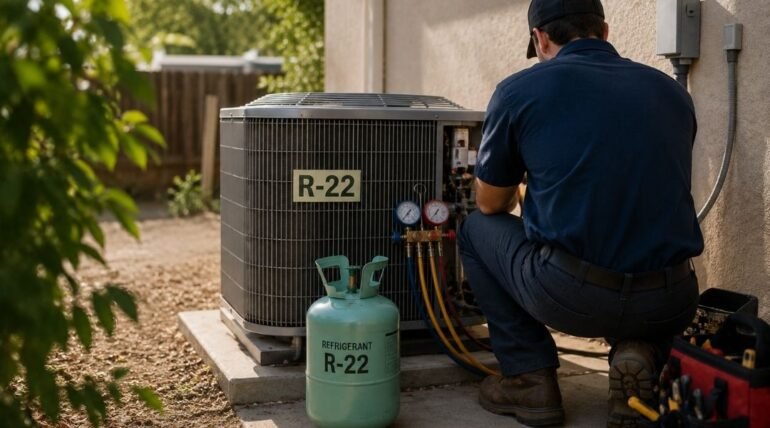
The fastest way to check is to walk to your outdoor condenser unit and look at the manufacturer label on the side or back of the unit. It will list the refrigerant type — look for “R-22” or “HCFC-22.” If your system was installed before 2010 and has never been replaced, it almost certainly uses R-22.
If the label is faded or missing, a licensed HVAC technician can confirm the refrigerant type during a service call. You can also check your original installation paperwork or owner’s manual. If you are unsure, a quick photo of the unit’s data plate sent to your HVAC contractor will give you the answer immediately.
One critical rule: never allow an HVAC technician to add R-410A — the refrigerant used in systems manufactured between 2010 and 2024 — to an R-22 system. R-410A operates at significantly higher pressures than R-22 and adding it to an R-22 system can cause severe damage, up to and including catastrophic compressor failure. These are incompatible refrigerants and must never be mixed.
Your Three Options as an R-22 System Owner in Los Angeles in 2026
If your system uses R-22, you have three realistic paths forward. Each has a legitimate use case — and each has clear limitations that make it the wrong choice in certain situations.
Option 1 — Maintain and Monitor Until End of Life
If your R-22 system is currently sealed, not leaking, and performing adequately, the most financially conservative path is to maintain it with regular service, change filters consistently, and plan for its eventual replacement without adding expensive refrigerant unless absolutely necessary.
When this makes sense: Your system has no active refrigerant leak, is maintaining temperature adequately, and is otherwise functional. A well-maintained sealed system will not require refrigerant top-up — refrigerant does not deplete during normal operation. Continue annual professional maintenance and begin saving for replacement.
When this stops making sense: The moment the system develops a refrigerant leak, the economics of continued investment change dramatically. A leak that costs $800 to $3,000 to repair and recharge on a 16-year-old system — on equipment that is already at or past its expected lifespan in Los Angeles’s demanding climate — is almost never the right financial decision. For guidance on how LA’s climate shortens AC lifespan compared to national averages, see: How Long Does an AC Unit Last in Los Angeles?
Option 2 — Retrofit With a Drop-In Refrigerant Alternative
Several refrigerant blends — including R-407C, R-422D, and R-422B — are marketed as drop-in alternatives to R-22 that can work in existing R-22 systems after a technician flushes and converts the system. A retrofit typically costs $300 to $800 including labor and refrigerant.
The real trade-offs: Retrofit refrigerants deliver 5 to 10% efficiency reduction compared to R-22 in the same system. Some manufacturer warranties are voided by retrofitting with non-approved refrigerants. And all current retrofit refrigerant alternatives are HFCs with significant Global Warming Potential ratings — they will face their own regulatory scrutiny under the EPA’s AIM Act HFC phase-down in the coming years. A retrofit buys time on an aging system, not a long-term solution.
When this makes sense: Your system is in otherwise good condition, you need to address an active refrigerant issue, and you are planning to replace the system within 2 to 3 years but cannot do so immediately. A retrofit extends the operational window without the full investment of R-22 recharge costs.
Option 3 — Replace the System Now
For most Los Angeles homeowners with R-22 systems in 2026, system replacement is the most financially rational path — particularly when the full 5-year cost comparison is calculated honestly. A system that is at minimum 16 years old, operating in LA’s demanding 7 to 8 month cooling season, on a refrigerant whose cost will continue escalating, is a system running on borrowed time.
The case for replacement becomes especially compelling when you factor in the LADWP rebate opportunity currently available: qualifying heat pump installations receive up to $2,500 per ton — on a 3-ton system, that is up to $7,500 back. That rebate does not exist for R-22 system maintenance or repair. It exists specifically for new high-efficiency system installations — and it is the most generous utility-funded heat pump rebate in California right now.
| Cost Comparison | Keep R-22 System | Replace With Heat Pump |
|---|---|---|
| Immediate cost (recharge + leak repair) | $800 – $3,000 | $0 (new system) |
| New system installed cost (3-ton) | — | $9,500 – $15,000 |
| LADWP rebate (3-ton × $2,500) | Not available | Up to −$7,500 |
| Net replacement cost after rebate | — | As low as $2,000 – $7,500 |
| Annual energy savings (40% efficiency gain) | — | $600 – $1,500/yr |
| Annual refrigerant cost risk (leaking system) | $400 – $700/yr and rising | $0 — modern refrigerant, no supply constraints |
| Estimated 5-year total cost | $6,000 – $15,000+ | $0 – $6,000 after rebate and energy savings |
For the full rebate details and how to qualify, see: LADWP Heat Pump Rebate 2026: How to Qualify and Maximize Your Savings. For a complete heat pump installation cost breakdown, see: Heat Pump Installation in Los Angeles: Costs, Rebates and Everything Homeowners Need to Know.
The 2030 Deadline and What It Means for R-22 Owners
January 1, 2030 marks the final phase of the R-22 ban — the prohibition on remaining production and import of all HCFCs. While the supply of reclaimed R-22 will not immediately disappear on that date, the trajectory is clear: every year from now until 2030, the available reclaimed supply pool shrinks as more old systems are retired and no new reclamation sources emerge to replace what is consumed.
The practical implication for Los Angeles homeowners still running R-22 systems is simple: the cost of servicing these systems will continue climbing every year, and the availability of technicians who stock and work with R-22 will narrow. Waiting until 2028 or 2029 to replace a failing R-22 system means replacing under pressure, during what is likely to be peak demand for replacement contractors, without the benefit of whatever rebate programs exist today.
This parallels the situation California is managing with the 2030 gas furnace sales ban — a regulatory deadline that rewards early movers with access to rebates and planned replacement timing, and penalizes late movers with emergency replacement under constrained conditions. For more on that parallel timeline, see: California Gas Furnace Ban 2030: What Los Angeles Homeowners Need to Know.
The Mistake Most R-22 System Owners Make
The most common pattern we see with R-22 systems in Los Angeles is the incremental repair trap: a homeowner invests $900 in a recharge, then $1,200 in a leak repair the following summer, then another $800 in refrigerant after a second leak develops — spending $3,000 or more over three years on a system that is simultaneously consuming 30 to 40% more electricity than a modern replacement would, and is no closer to solving the underlying problem than after the first repair call.
Each individual repair feels like the cheaper decision in the moment. The cumulative cost tells a different story. For a detailed guide to how to evaluate repair versus replacement decisions on aging systems, see: Your Old AC Is Costing You More Than a Brand New One Would and The 14-Year-Old AC Replacement Mistake Los Angeles Homeowners Make.
What Refrigerant Does a New System Use in 2026?
New residential HVAC equipment manufactured in 2025 and 2026 uses next-generation low-GWP refrigerants — primarily R-454B (sold under brand names such as Carrier’s Puron Advance) and R-32. These refrigerants have significantly lower Global Warming Potential than both R-22 and R-410A, and meet the EPA’s January 1, 2026 requirement that new residential HVAC equipment use refrigerants with a GWP of 700 or lower.
R-410A — which replaced R-22 as the industry standard from 2010 to 2024 — is no longer used in new residential equipment manufactured after January 1, 2025. However, existing R-410A systems can continue to be serviced and recharged for decades using stockpiled and reclaimed refrigerant. If your system uses R-410A (installed between 2010 and early 2025), it is not in the same position as an R-22 system — servicing remains fully viable for the foreseeable future, though costs are rising.
Preventive Maintenance to Protect an R-22 System You Are Not Ready to Replace Yet
If replacement is not immediately feasible, the highest-value action you can take with an R-22 system is ensuring it stays sealed. Refrigerant does not deplete during normal operation — if your system is low on R-22, it has a leak. Catching and repairing small leaks before they become large leaks significantly reduces the refrigerant cost exposure over the remaining life of the system.
- Annual professional tune-up in March or April — before the cooling season begins. A tune-up includes a refrigerant level check and pressure test that can identify developing leaks before they become expensive failures mid-summer. For what a professional tune-up covers, see: How Seasonal Tune-Ups Can Prevent Major Repairs and System Failures.
- Monthly filter changes during the cooling season — reducing airflow restriction reduces strain on an already-aging compressor and helps avoid the frozen coil and refrigerant pressure issues that can accelerate leaks in older systems.
- Condenser coil cleaning annually — keeping the outdoor coil clean reduces the head pressure the compressor must work against, reducing thermal stress on aging components.
- Do not ignore early warning signs — ice on refrigerant lines, warm air from supply vents, or the system running longer than usual to maintain temperature are all indicators of a developing refrigerant issue. Catching these early reduces the total cost of the repair event. For the full list of warning signs, see: 5 Warning Signs Your AC Needs Repair Before It Breaks Down Completely.
For a complete year-round maintenance guide for Los Angeles homes, see: Air Conditioner Maintenance in Los Angeles.
Frequently Asked Questions
Can I still get my R-22 AC serviced in Los Angeles in 2026?
Yes — licensed HVAC technicians can still service R-22 systems using reclaimed refrigerant. However, the supply of reclaimed R-22 is finite and shrinking, which is why prices have escalated so dramatically. Servicing is still possible, but increasingly expensive, and that trajectory will continue through 2030 and beyond.
Can I add R-410A to my R-22 system to save money?
No — and doing so can cause serious damage. R-410A operates at significantly higher pressures than R-22 and the two refrigerants are chemically incompatible. Adding R-410A to an R-22 system is unsafe and can result in catastrophic compressor failure. This substitution should never be attempted.
Is it illegal to run an R-22 air conditioner in California?
No. Operating an existing R-22 system is legal. The ban applies to the production and import of new R-22 refrigerant, not the operation of existing equipment that contains it. Your R-22 system can continue running legally — it simply becomes progressively more expensive to service as refrigerant supply shrinks.
What is the best replacement for an R-22 AC system in Los Angeles?
For most Los Angeles homeowners, a heat pump system is the most financially rational replacement — it handles both heating and cooling in one unit, qualifies for LADWP rebates of up to $2,500 per ton, uses modern low-GWP refrigerants, and delivers 30 to 40% better energy efficiency than the aging R-22 system it replaces. For a full comparison of heat pump options and costs, see: Heat Pump vs. Gas Furnace in California: Which Is the Smarter Choice in 2026?
What if my R-22 system fails during a summer heat wave?
An R-22 system failure during a Los Angeles heat wave — when technician availability is most constrained and replacement lead times are longest — is the worst scenario for both cost and comfort. This is precisely why proactive replacement before failure is strongly advisable. For what an emergency AC failure situation looks like in LA during peak demand, see: It’s 104°F Inside Your House and Every Technician Is Booked in LA.
TOP AC Inc. — Honest Guidance on R-22 Systems Across the San Fernando Valley
At TOP AC Inc., we give every R-22 system owner in Los Angeles a straight answer: we assess the system’s condition, calculate the realistic 3-year cost of keeping it running versus replacing it with a qualifying heat pump, confirm your LADWP rebate eligibility, and give you the numbers to make an informed decision — without pressure in either direction.
If your system is sealed and functional, we will tell you to maintain it and plan for replacement. If a repair quote has crossed the threshold where replacement makes more financial sense, we will show you the math clearly. And if you are ready to replace, we handle permitting, equipment selection, rebate documentation, and installation — with $0 down financing options available.
We serve homeowners throughout a 10-mile radius of our Canoga Park headquarters, including:
- Canoga Park 91303, 91304
- Woodland Hills 91364, 91367
- West Hills 91307, 91308
- Winnetka 91306
- Chatsworth 91311
- Northridge 91324, 91325, 91326
- Granada Hills 91344
- Porter Ranch 91326
- Reseda 91335
- Tarzana 91356, 91357
- Encino 91316, 91436
- Sherman Oaks 91403, 91423
📞 Call us at (855) 999-8672
🌐 top-ac.com
📍 21201 Victory Blvd, Suite 102, Canoga Park, Los Angeles, CA 91303
🕐 Available 24/7 — Residential & Commercial
Call today for a free honest assessment of your R-22 system — and a clear picture of exactly what keeping it running will cost versus what replacing it would save.