
November 18, 2026
Ductless Versus Central Air for San Fernando Homes
For ductless versus central air, the better choice depends on your home’s layout, existing equipment, comfort concerns, and budget. Central air is often practical for a home with usable ducts, while ductless mini splits can deliver targeted comfort where ducts are absent, inefficient, or simply not serving a room well.
That decision matters during a Canoga Park or Woodland Hills heat wave, when one warm upstairs bedroom or overworked AC system can affect the whole household. The right system should cool reliably, control operating costs, and fit the way your family actually uses each room.
How ductless and central air work
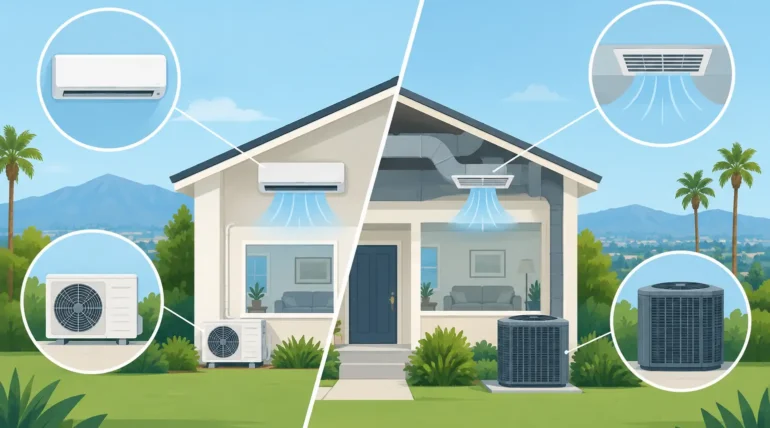
Central air conditioning uses one outdoor unit connected to an indoor coil and a network of ducts. Cooled air travels through supply vents to serve multiple rooms from a central thermostat. If your home already has ducts in good condition and the system is properly designed, this can be a familiar, straightforward whole-home solution.
Ductless mini splits use an outdoor unit connected to one or more indoor air handlers. Each indoor unit serves a specific room or zone and has its own temperature control. Instead of pushing cooled air through ducts, the system conditions the air directly in the space where the unit is installed.
Many ductless systems are heat pumps, which means they can provide both cooling and heating. That can be useful on chilly Valley nights, especially for additions, converted garages, home offices, or rooms that never seem comfortable with the existing system.
Ductless versus central air at a glance
| Factor | Ductless mini split | Central air | |—|—|—| | Best fit | Additions, individual rooms, homes without suitable ducts | Whole-home cooling with functional existing ducts | | Temperature control | Separate zones can be set independently | One thermostat often controls a larger area | | Indoor appearance | Wall, ceiling, or floor-mounted indoor units are visible | Most equipment is hidden, with vents in rooms | | Installation scope | No new duct network required | Relies on existing ducts and their condition | | Efficiency potential | Strong for occupied-zone cooling | Can be efficient when equipment and ducts are well maintained | | Upfront investment | Can start lower for one room, rise with multiple zones | Often cost-effective for a full home with good existing ducts |
Neither option wins in every house. A single ductless unit may be the sensible answer for a hot primary bedroom, but it is not automatically the least expensive way to cool an entire 2,000-square-foot home. Likewise, replacing a central system may make sense when the ducted layout already provides even comfort and the ducts are in usable condition.
When central air is usually the better fit
Central air often makes the most sense for homeowners replacing an existing ducted system. The vents are already where you need them, the home is accustomed to one thermostat, and the goal is consistent comfort across most or all rooms.
It can also be the cleaner-looking choice for homeowners who prefer equipment to stay out of sight. Indoor air is delivered through registers rather than wall-mounted heads, so the rooms retain their existing appearance.
A central system deserves a closer look if your current issue is age or reliability rather than uneven cooling. A professional evaluation can determine whether the problem is the equipment, thermostat settings, airflow restrictions, insulation, or maintenance needs. For recurring breakdowns, review your options for AC installation and replacement instead of continuing to put money into an unreliable unit.
Central air does have a limitation: it depends heavily on the condition of the ducts already in the house. Leaks, poor insulation around ducts, blocked returns, or an imbalanced layout can contribute to hot and cold spots. TOP AC does not install ductwork, but an honest assessment should account for how the existing duct system affects your results.
When ductless mini splits make more sense
Ductless is especially useful when one part of the home has different comfort needs than the rest. Think of a sun-facing bedroom, a detached workspace, a remodeled room, or a garage conversion where extending the existing system is not practical. It lets you cool the space you use without changing the temperature everywhere else.
Zoning is the main advantage. If one family member likes a cooler bedroom and another prefers a warmer living room, separate indoor units can reduce the daily thermostat debate. You can also turn down conditioning in unoccupied rooms rather than cooling the full house the same way all day.
Ductless can be a smart choice for older homes that do not have a suitable ducted layout. It avoids the need for a new duct network, although each indoor unit still needs professional placement, electrical connections, refrigerant lines, condensate drainage, and a correctly sized outdoor unit.
There are trade-offs. Indoor air handlers are visible, and multi-zone systems need thoughtful planning. A system with too few zones may not solve comfort problems, while adding units to every room can raise the project cost. Placement also matters because a unit should distribute air across the room without blowing directly on beds, desks, or seating areas.
Cost estimates: what homeowners should expect
Every home needs an on-site evaluation before a firm proposal. Square footage alone does not establish the right system size, and a lower bid is not a value if it overlooks electrical capacity, equipment placement, permit requirements, or the condition of existing components.
As broad estimates, replacing a central AC or heat pump system in a home with usable existing ducts may range from roughly $8,000 to $18,000 or more. A single-zone ductless mini split may range from about $4,000 to $7,000 installed, while multi-zone ductless systems commonly range from about $9,000 to $20,000 or more. Equipment efficiency, access, electrical work, number of zones, and the home’s design can move those figures substantially.
Permits may be required for HVAC replacement or new installations in local jurisdictions. A licensed contractor should address permit needs upfront, not leave homeowners to discover the issue after work begins.
TOP AC provides a Free Estimate on new systems and offers financing through Wells Fargo. Qualifying Mitsubishi Electric systems can carry up to a 12-year manufacturer warranty, and TOP AC separately provides its own 10-year labor warranty on every system it installs. Those are different protections, so it is worth reviewing both before you decide.
Efficiency is about more than the equipment label
A high-efficiency rating can help, but daily performance comes down to installation quality and how the home holds conditioned air. In the San Fernando Valley, summer sun and long stretches of high temperatures can expose weak attic insulation, air leaks, and rooms with heavy west-facing exposure.
If the second floor is always hotter or the system runs for long periods without catching up, compare your HVAC options alongside attic and crawl space insulation. Better insulation can reduce heat gain and help either a ductless or central system maintain comfort with less strain.
For homes affected by wildfire smoke or seasonal outdoor air concerns, comfort is not only about temperature. Ask how filtration and indoor air quality options can work with your selected system. TOP AC offers indoor air quality services focused on filtration, purification, and related solutions that support cleaner indoor air.
Questions to answer before choosing
Start with the rooms that cause the most frustration. Is the entire home uncomfortable, or only a few spaces? Are the existing ducts serving the rooms well? Do household schedules mean some rooms sit empty most of the day? Are you replacing equipment that has become unreliable, or trying to solve a specific hot-room problem?
Also consider future plans. If you expect to use a home office daily, finish an addition, or want more independent temperature control as the household changes, ductless zoning may have lasting value. If you want consistent whole-home comfort from a familiar system and your ducts support it, central air may be the simpler path.
A licensed evaluation should include load calculations, equipment location, drainage, electrical requirements, thermostat or zone controls, and permit considerations. TOP AC Inc. has been family-owned since 2011 and is licensed and insured under CSLB #959168. The goal is not to steer every homeowner toward one system, but to recommend the option that fits the house and the people living in it.
Maintenance keeps either system dependable
Both system types need regular care. Central systems benefit from clean filters, clear outdoor equipment, and professional checks of refrigerant performance, electrical components, drainage, and airflow. Ductless systems need their filters cleaned and indoor heads inspected so dust buildup does not reduce performance or affect air quality.
If your current equipment is noisy, leaking, cycling frequently, or failing to cool, schedule AC repair before a minor issue becomes a midsummer breakdown. For proactive care, TOP CLUB residential maintenance plans start at $15 per month and can help homeowners stay ahead of seasonal service needs.
FAQs
Is ductless cheaper than central air?
Ductless can cost less when you only need to cool one room or a small area. For whole-home cooling with several indoor units, a multi-zone ductless system may cost as much as or more than central air, particularly when a home already has usable ducts.
Can a ductless mini split cool an entire home?
Yes, a properly designed multi-zone ductless system can serve an entire home. The key is correct sizing and placement for each zone, rather than assuming one indoor unit can reach through hallways and closed doors.
Does central air work better in Valley heat?
Either system can perform well in Valley heat when it is properly sized, installed, and maintained. Central air is often a strong whole-home option with functional ducts, while ductless can be especially effective for difficult rooms that receive intense afternoon sun.
Do ductless systems provide heat too?
Many ductless mini splits are heat pumps that provide both air conditioning and heating. This can make them useful for rooms that need year-round comfort, though the right setup depends on your home’s heating needs and existing equipment.
How often should ductless or central AC be serviced?
Most homeowners should plan professional maintenance at least once a year, ideally before heavy cooling season. Regular service helps identify worn parts, drainage problems, airflow issues, and performance changes early.
Need help choosing the right system?
Need help with ductless versus central air? Call TOP AC at (855) 999-8672 or request a Free Estimate at top-ac.com/contact/. If you already have a system you want to protect, ask about TOP CLUB maintenance for dependable seasonal care.
The best choice is the one that keeps your home comfortable in the rooms you use most, without creating surprises in your budget or your next heat wave.