
June 23, 2026
Stop Fighting Over the Thermostat — Here Is How HVAC Zoning Actually Works in Los Angeles Homes
If your household has ever had an argument about the thermostat — one person freezing in the bedroom while another is sweating in the living room, or a guest room getting the same treatment as the primary suite nobody uses during the day — you already understand the problem that HVAC zoning exists to solve.
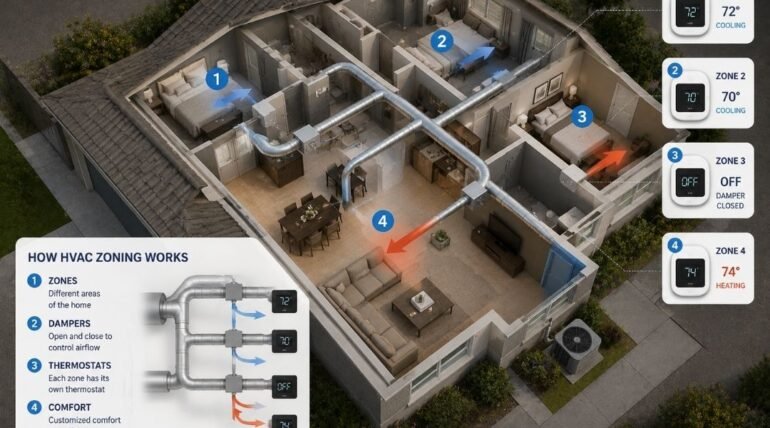
An HVAC zoning system in Los Angeles divides your home into independently controlled temperature zones, each with its own thermostat and its own call for cooling or heating. Instead of one setting trying to satisfy every room simultaneously, each zone gets exactly what it needs when it needs it. The result is better comfort, measurably lower energy bills, and significantly less wear on your HVAC equipment over time.
This guide covers everything LA homeowners need to know before making the decision: exactly how zoning works, what it costs in the 2026 Los Angeles market, which homes benefit most, how it compares to ductless mini-splits, and what to watch out for during installation.
What an HVAC Zoning System Actually Is — and How It Works
A zoning system is not a separate HVAC unit. It is a control layer added to your existing central heating and cooling system that determines where conditioned air goes — and where it does not. Your existing equipment continues doing the same job. The zoning system decides how to distribute the output intelligently based on real-time demand from each area of your home.
The four components that make it work:
- Zone control panel: The brain of the system. It receives temperature signals from each zone’s thermostat and translates them into commands for the dampers. Most residential zone controllers support 2 to 8 zones on a single panel. When Zone 1 calls for cooling and Zone 3 is already satisfied, the panel opens dampers to Zone 1 and keeps Zone 3 closed — directing available airflow where it is actually needed.
- Motorized zone dampers: Installed inside your ductwork branch runs. When a zone calls for cooling, its damper opens. When the zone reaches its setpoint, the damper closes. This happens automatically and continuously based on real-time readings from each thermostat.
- Individual thermostats or sensors: Placed in the primary living area of each zone — not in hallways or unused corners. Each thermostat monitors its zone independently and sends demand signals to the control panel.
- Bypass damper (sometimes required): Single-stage HVAC systems produce a fixed volume of airflow. When multiple zones close simultaneously, the remaining open zone cannot absorb full airflow without pressure buildup. A bypass damper routes excess air back to return. Two-stage and variable-speed systems modulate output naturally and typically do not require a bypass — one reason variable-speed equipment pairs particularly well with zoning.
Why Los Angeles Homes Need Zoning More Than Most
Zoning is not equally valuable in every market. In Los Angeles — and particularly across San Fernando Valley communities — several specific factors make it significantly more impactful than in moderate climates.
Temperature Differentials Between Floors Are Extreme in LA Heat
Heat rises. In a two-story Los Angeles home during a summer heat wave, the temperature differential between the ground floor and the upper floor commonly reaches 10 to 15°F. A single thermostat on the ground floor will either overcool the downstairs to satisfy the upstairs, or leave the upstairs uncomfortably hot while the downstairs reaches its setpoint. A two-zone system — upper floor and lower floor — solves this completely and is the most common zoning configuration in two-story LA homes.
West-Facing Rooms vs. Shaded Rooms
Los Angeles’s afternoon sun is directional and intense. A west-facing living room in Canoga Park or Woodland Hills that absorbs direct afternoon sun from 2pm to 6pm in July needs significantly more cooling than a north-facing bedroom at the same moment. A single thermostat placed in one room forces the entire system to choose between satisfying the sun-baked room or wasting energy overcooling the shaded one. Zoning treats them independently — solving a comfort problem that thermostat adjustments alone never will.
The Long LA Cooling Season Amplifies Every Efficiency Gain
HVAC systems in Los Angeles run 7 to 8 months per year — far longer than most US markets. A system that reduces cooling energy consumption by 35% delivers those savings across the full season, not 3 or 4 months as in moderate climates. The financial return on a zoning investment compounds proportionally with the length of the cooling season. For a full look at LA’s energy cost landscape, see: Los Angeles HVAC Energy Savings.
Home Offices, Guest Rooms, and Underused Spaces
The increase in remote work has changed how LA homes are actually used day to day. One or two rooms function as offices during business hours while the rest of the home sits empty. Conditioning the entire house to keep one office comfortable wastes the energy spent on every unoccupied room. Zoning lets you cool the office zone during working hours and the bedroom zone in the evening — with the rest of the home on setback. The savings add up quickly in LA’s electricity rate environment.
The Two Approaches to Zoning in Los Angeles Homes
When contractors talk about “zoned HVAC,” they can mean two fundamentally different things. Understanding the distinction before getting quotes protects you from comparing proposals that are not actually comparable.
Approach 1 — Ducted Zoning (Adding Dampers to Your Existing System)
This is the classic zoning configuration: your existing central HVAC system stays in place, and a zone control panel plus motorized dampers are added to your existing ductwork. This is the right approach when your existing ducts are in good condition and your HVAC equipment is relatively new — it adds zone control to infrastructure you have already paid for.
For this approach to work well, your ductwork must be in sound condition. Leaking or deteriorated ducts undermine the efficiency gains that zoning delivers. If your ductwork is aging, the conversation about zoning and the conversation about duct condition need to happen at the same time before any equipment is ordered.
Approach 2 — Ductless Mini-Split Zoning
Mini-split systems are inherently zoned — each indoor air handler serves one zone independently, controlled by its own thermostat or remote. A multi-zone mini-split system (one outdoor unit connected to multiple indoor heads) delivers zone control without any ductwork at all. This is the right approach for older LA homes without existing ductwork, home additions, ADUs, and converted garages.
The trade-off is upfront cost per zone — ductless zoning costs more per zone than adding dampers to existing ductwork. The offset is the elimination of duct losses (20 to 30% of conditioned air can escape through leaky ducts in older LA homes) and the higher SEER2 efficiency ratings that mini-split systems achieve. For a detailed look at mini-split options and our current installation pricing in Los Angeles, see: Mitsubishi Mini-Split Installation in Los Angeles and our full Top 10 Mini-Split AC Brands in Los Angeles 2026 guide.
HVAC Zoning Cost in Los Angeles in 2026
Zoning costs in Los Angeles are toward the higher end of national ranges, reflecting the city’s elevated labor rates and the complexity of working in older housing stock with varying ductwork configurations.
| Zoning Configuration | Typical Cost — LA 2026 | Notes |
|---|---|---|
| 2-zone system added to existing ducted HVAC | $1,700 – $2,800 | Most common entry-level configuration — upper/lower floor or living/sleeping zones |
| Each additional zone beyond 2 | $350 – $500 per zone | Incremental cost for damper, wiring, and thermostat per additional zone |
| 3-zone ducted system | $2,050 – $3,300 | Common in 3-bedroom homes with distinct living, sleeping, and office areas |
| 4-zone ducted system | $2,400 – $3,800 | Larger homes — independent control of up to 4 distinct areas |
| Zone control panel | $200 – $600 | Central controller — included in above estimates for most installations |
| Smart thermostat per zone | $100 – $250 each | Recommended — enables scheduling, remote access, and demand response |
| Bypass damper (if required) | $200 – $500 | Required for single-stage systems — not needed for two-stage or variable-speed |
| Ductless mini-split — 2-zone system | $7,200 – $10,800 | Full installed cost — higher per zone but no duct losses and higher efficiency |
| Ductless mini-split — 3 to 4 zone system | $10,800 – $16,500 | Whole-home ductless zoning — best for older LA homes without ductwork |
The most cost-effective time to add ducted zoning is during an HVAC system replacement — when the contractor is already on-site and the ductwork is accessible. Adding zoning at the time of a new system installation typically costs 20 to 30% less than retrofitting zoning onto an existing system at a later date. If your HVAC system is approaching end of life, discuss zoning as part of the replacement conversation — not as a separate future project. For what replacement costs look like in the current LA market, see: Heat Pump Installation in Los Angeles: Costs, Rebates and Everything Homeowners Need to Know.
How Much Can You Actually Save with HVAC Zoning in Los Angeles?
The energy savings data for residential HVAC zoning is well-documented. Zoned air distribution systems can deliver more than 10% savings on heating and over 35% savings on cooling in typical homes — according to studies referenced by the California HVAC industry. HVAC systems account for approximately 40% of a home’s total energy consumption, making cooling efficiency improvements among the highest-return changes an LA homeowner can make.
| Scenario | Annual Cooling Cost (Before) | Estimated Savings with Zoning | Approx. Payback |
|---|---|---|---|
| Average 3-bedroom LA home, LADWP customer at $0.25/kWh average | ~$1,800/yr | $540 – $630/yr (30–35% cooling savings) | 3–5 years |
| Two-story San Fernando Valley home, SCE customer at $0.35/kWh | ~$2,600/yr | $780 – $910/yr (30–35% cooling savings) | 2–4 years |
| Home with significant unused rooms (guest rooms, formal dining) | ~$2,000/yr | $700 – $900/yr (35–45% with optimal zone scheduling) | 2–4 years |
Beyond energy savings, zoning reduces HVAC equipment runtime and short-cycling — particularly in variable-speed systems where the equipment modulates to meet actual demand rather than running at full capacity for brief cycles. Less runtime and smoother operation directly extend the operational life of the compressor and blower motor. For context on how LA’s operating conditions affect system lifespan, see: How Long Does an AC Unit Last in Los Angeles?
Which Los Angeles Homes Benefit Most from Zoning
| Home Profile | Why Zoning Delivers the Most Value |
|---|---|
| Two-story homes throughout the San Fernando Valley | 10–15°F floor-to-floor differential during summer heat events. A 2-zone upper/lower configuration solves the most common LA comfort complaint at the lowest zoning cost entry point. |
| Homes with west-facing primary living areas | Afternoon solar gain in west-facing rooms creates dramatic temperature differences from other parts of the same home. Zoning allows targeted cooling of the affected area without overcooling shaded rooms. |
| Homes with a dedicated home office | Office zone cooled during business hours only — rest of home on setback. Savings are concentrated and measurable, often providing the fastest payback of any zoning configuration. |
| Larger homes with frequently unused rooms | Guest bedrooms, formal dining rooms, and game rooms that sit empty most of the week do not need to be conditioned at the same level as primary living spaces. Zoning eliminates this waste. |
| Homes with ADUs or converted garages on the same system | ADU occupancy often follows a completely different schedule than the main home. Separate zoning prevents the entire system from running to satisfy one small space while the rest of the home is unoccupied. |
| Homes where occupants have different temperature preferences | The most direct solution to thermostat disputes — each zone is set independently by whoever uses it, with no compromise required for the rest of the home. |
Zoning vs. Mini-Splits: The Honest Comparison for LA Homeowners
The choice between ducted zoning and ductless mini-splits is the most common question homeowners ask once they understand that both deliver independent zone control. The right answer depends almost entirely on your existing infrastructure.
| Factor | Ducted Zoning | Ductless Mini-Split Zoning |
|---|---|---|
| Upfront cost (2-zone) | $1,700 – $2,800 | $7,200 – $10,800 |
| Requires existing ductwork | Yes — must be in good condition | No — installs without ductwork |
| Efficiency rating | Depends on central system SEER2 | 18–33.1 SEER2 — inherently higher |
| Duct loss risk | Yes — leaky ducts reduce savings | None — no duct distribution losses |
| LADWP rebate eligible | Not for zoning controls alone | Yes — heat pump mini-splits qualify for up to $2,500/ton |
| Installation disruption | Moderate — dampers added to existing ducts | Low — 3-inch wall penetration per zone, no duct work |
| Best for | Homes with good existing ductwork and newer HVAC systems | Older homes without ductwork, additions, ADUs |
The LADWP rebate eligibility difference is significant. Mini-split heat pumps qualify for up to $2,500 per ton in LADWP rebates — ducted zoning controls added to an existing system do not. On a 2.5-ton two-zone mini-split system, that represents up to $6,250 back, which dramatically changes the net cost comparison between the two approaches. For the full rebate guide, see: LADWP Heat Pump Rebate 2026: How to Qualify and Maximize Your Savings.
Also worth noting in the context of California’s 2030 gas furnace sales ban: a mini-split heat pump installation is inherently future-proof under California’s electrification direction. A ducted zoning upgrade on a system that still relies on a gas furnace for heating is an improvement that will eventually need to be revisited when the furnace reaches end of life. For more on that timeline, see: California Gas Furnace Ban 2030: What Los Angeles Homeowners Need to Know.
What to Watch Out For When Installing HVAC Zoning in Los Angeles
Zoning is a powerful upgrade when designed and installed correctly — and a source of persistent problems when it is not. These are the most common installation mistakes that lead to poor performance:
- Ductwork condition not assessed first. Adding zone control to a duct system that leaks 20 to 30% of conditioned air is like installing a sophisticated irrigation system on a broken pipe network. The zoning will direct airflow correctly, but a significant portion will escape before it reaches its destination. Always request a duct condition assessment before any zoning proposal is finalized.
- No bypass damper on a single-stage system. A single-stage system without a bypass damper will over-pressurize when multiple zones close simultaneously — forcing air through partially open registers at high velocity, creating noise and potentially damaging ductwork over time. This is a basic design requirement that should be in every reputable contractor’s zoning proposal for single-stage equipment.
- Thermostat placement in hallways or unused rooms. A thermostat placed in a hallway reads ambient air temperature that does not reflect the actual thermal condition of the zone. Always specify thermostat placement in the primary occupied area of each zone — where the temperature reading actually matters.
- Too many zones for the system’s capacity. Every zone added to a system increases the control complexity. A 4-zone system on a central unit that was sized for the whole home as a single zone may underperform if the equipment cannot modulate adequately for partial-load conditions. A proper zoning design should account for equipment staging or variable-speed capability alongside the number of zones.
- Skipping the permit. Zoning system installation in Los Angeles requires a mechanical permit from LADBS. Unpermitted HVAC control work creates liability at resale and can affect homeowner insurance. Always confirm your contractor is pulling the required permits.
For guidance on how to evaluate HVAC contractor proposals and avoid common overcharging patterns in the LA market, see: How to Avoid High HVAC Repair Costs in Los Angeles.
Title 24 and Permit Requirements for HVAC Zoning in Los Angeles
California’s Title 24 Building Energy Efficiency Standards address HVAC zoning design directly — including mandatory control requirements, setback programming requirements, and documentation obligations. For residential zoning installations in Los Angeles, the key requirements are:
- All thermostats must be capable of setback programming — a requirement that effectively mandates programmable or smart thermostats in any permitted zoning installation
- Zone control systems must be compatible with the installed HVAC equipment’s staging or modulation capability
- All ductwork modifications made during zoning installation are subject to the same Title 24 duct leakage testing requirements as any other ductwork work — HERS testing may be triggered
- A mechanical permit is required from LADBS for all zoning control system installations
A licensed HVAC contractor familiar with Los Angeles permitting and Title 24 compliance handles all of this as part of a standard installation. If a contractor proposes skipping permits or dismisses Title 24 documentation requirements, that is a red flag about the quality of the overall project. For more on how California’s evolving energy efficiency standards affect HVAC decisions in the San Fernando Valley, see: Canoga Park Net Zero HVAC Standards 2026.
Maintaining a Zoned HVAC System in Los Angeles
A zoned system has more components than a standard single-zone system — more thermostats, more dampers, and a control panel — which means there are more points to inspect during annual maintenance. The additional complexity is not burdensome, but it does mean that annual professional tune-ups should explicitly include damper operation checks, control panel diagnostics, and thermostat calibration across all zones.
Damper actuators — the motorized mechanisms that open and close each damper — are the most commonly replaced component in aging zoning systems. A damper stuck in the open or closed position causes a specific comfort symptom: one zone that is always too cold or always too warm regardless of thermostat setting. This is almost always a damper actuator issue and is an inexpensive repair when caught during a scheduled tune-up rather than diagnosed during a summer service call.
For what a comprehensive annual tune-up should cover on any LA HVAC system, see: How Seasonal Tune-Ups Can Prevent Major Repairs and System Failures and Air Conditioner Maintenance in Los Angeles.
Frequently Asked Questions
Is HVAC zoning worth it in Los Angeles?
For most LA homes — particularly two-story homes, homes with west-facing living areas, and homes where rooms are used on different schedules — yes. Zoning can reduce cooling costs by up to 35% and typically pays for itself within 3 to 5 years in LA’s electricity rate environment. The return is strongest in homes where the existing HVAC is already adequately sized and the ductwork is in good condition.
How many zones does my LA home need?
The most common configurations are 2 zones (upper and lower floors) for two-story homes, and 2 to 3 zones (living areas vs. sleeping areas vs. office or guest areas) for single-story homes. A 4-zone configuration covers larger homes where multiple distinct areas have genuinely different occupancy schedules. Your contractor should evaluate your home’s layout, thermal exposure, and usage patterns before recommending a zone count — not just square footage.
Can I add zoning to my existing AC without replacing it?
Yes — provided your existing system is in reasonably good condition and your ductwork is sound. Adding a zone control panel and dampers to an existing central system is a standard retrofit. If your system is over 10 years old or your ductwork has significant leakage, the conversation about zoning and the conversation about system condition need to happen simultaneously. Adding zone control to a failing system or leaky ducts delivers limited benefit.
What is the difference between HVAC zoning and a smart thermostat?
A smart thermostat provides scheduling, remote control, and efficiency optimization for a single-zone system — all of one area at one temperature setting. Zoning creates physically separate temperature zones that can be at different temperatures simultaneously. Both are valuable — a smart thermostat on a zoned system delivers the full benefit of both technologies. For more on smart thermostat installation in Los Angeles, see our complete guide at Los Angeles HVAC Repair Costs for context on system upgrade decisions.
Does HVAC zoning reduce AC repair costs?
Yes — indirectly. By reducing the total runtime and thermal stress on the compressor and blower motor, a properly designed zoning system extends component life and reduces the frequency of wear-related failures. The most common LA AC repairs — capacitor failures and compressor overwork — are directly related to thermal cycling stress that zoning reduces. For the most common AC repairs in the LA market, see: 5 Warning Signs Your AC Needs Repair Before It Breaks Down Completely.
Can I add zoning when I install a new heat pump?
Yes — and this is the most cost-effective time to do it. Adding zoning during a new system installation costs 20 to 30% less than retrofitting it later. If you are planning a heat pump installation and your home profile suggests zoning would be beneficial, include it in the initial project scope. The combined efficiency of a high-SEER2 heat pump with zone control is the highest-performing residential HVAC configuration available for Los Angeles homes. For heat pump options and pricing, see: Heat Pump vs. Gas Furnace in California: Which Is the Smarter Choice in 2026?
HVAC Zoning Installation Across the San Fernando Valley — TOP AC Inc.
At TOP AC Inc., we design and install ducted zoning systems and ductless multi-zone mini-split systems across the San Fernando Valley. Before we recommend a configuration, we assess your home’s layout, ductwork condition, existing equipment, and how you actually use your space — then give you an honest recommendation on whether ducted zoning, ductless zoning, or a combination makes the most financial sense for your specific situation.
We handle all Title 24 compliance documentation and LADBS permitting, and we confirm LADWP rebate eligibility for any qualifying mini-split or heat pump installation before any work begins. We serve homeowners throughout a 10-mile radius of our Canoga Park headquarters, including:
- Canoga Park 91303, 91304
- Woodland Hills 91364, 91367
- West Hills 91307, 91308
- Winnetka 91306
- Chatsworth 91311
- Northridge 91324, 91325, 91326
- Granada Hills 91344
- Porter Ranch 91326
- Reseda 91335
- Tarzana 91356, 91357
- Encino 91316, 91436
- Sherman Oaks 91403, 91423
📞 Call us at (855) 999-8672
🌐 top-ac.com
📍 21201 Victory Blvd, Suite 102, Canoga Park, Los Angeles, CA 91303
🕐 Available 24/7 — Residential & Commercial
Call today for a free zoning consultation — we will assess your home, give you the real numbers, and tell you honestly whether zoning will deliver a meaningful return for your specific layout and usage.